
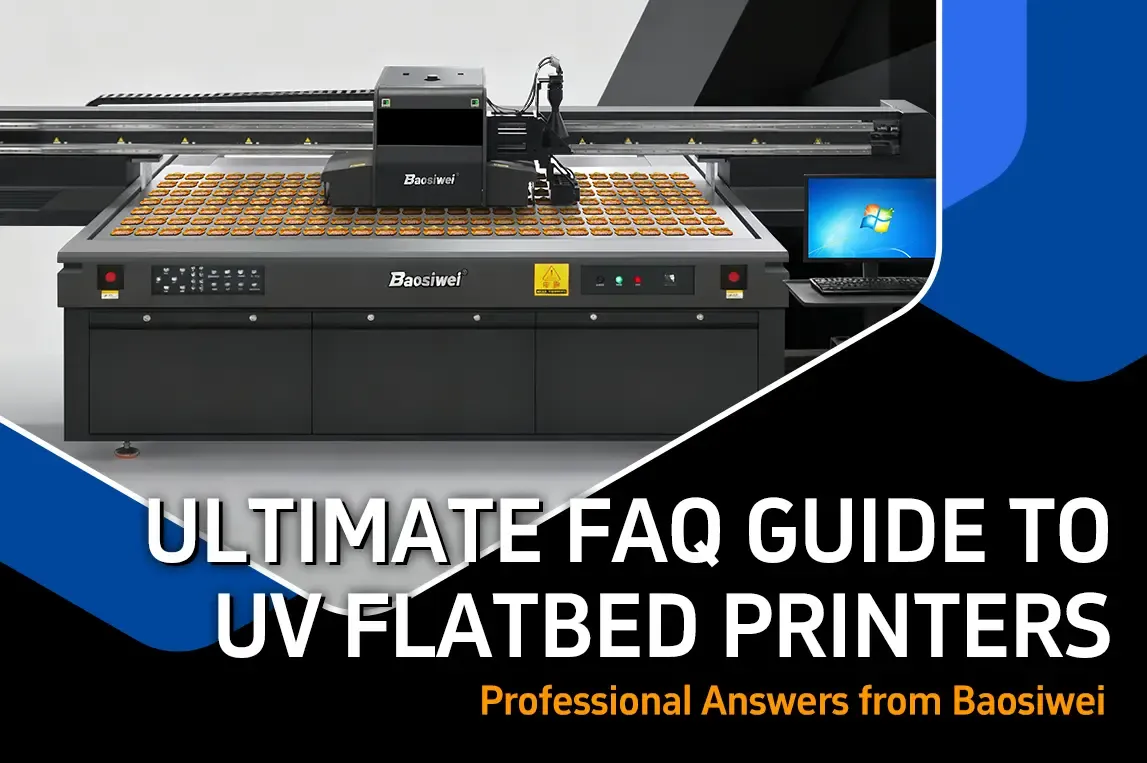
Ultimate FAQ Guide to UV Flatbed Printers|Professional Answers from Baosiwei
Ultimate FAQ Guide to UV Flatbed Printers|Professional Answers from Baosiwei
Through years of communication with customers from the United States, Europe, Southeast Asia, and the Middle East, we noticed that many users share the same concerns:
Is adhesion stable?
How long does the printhead last?
Is installation complicated?
Will the machine be damaged during shipping?
This FAQ summarizes the 10 most frequently asked questions from overseas customers and provides professional answers based on Baosiwei’s nearly 30 years of digital printing experience, helping you clearly determine whether UV flatbed printing is suitable for your business.
Q: What is a UV flatbed printer? Which industries is it suitable for?
A UV flatbed printer uses UV-curable ink and ultraviolet light to instantly cure the print. It can print directly on hard materials and certain flexible materials without plate-making or additional drying processes.
As a Chinese factory with nearly 30 years of experience in digital printing, Baosiwei understands overseas customers’ need for broad application coverage. Our UV flatbed printers support:
- Signage & Decoration Materials (acrylic, PVC, KT board, PS board)
- Furniture & Home Decor (wood panels, glass, tiles, cabinet doors)
- Crafts / Gifts (acrylic displays, wooden boxes, toys)
- Industrial Components (aluminum sheets, stainless steel, hardware)
If you need to enter additional niche markets, we can test adhesion and ink compatibility for your materials and provide sample output.
If you want a deeper understanding of UV flatbed printer applications, you can browse our previous blog:
Complete UV Printing Guide: 13 Proven Applications for Factory Production
Q: What materials can a UV flatbed printer print? How does Baosiwei ensure compatibility?
The most common concern from overseas users is:
“After I receive the machine, will the materials actually hold the ink? Is adhesion strong enough?”
Baosiwei performs dedicated process testing for different materials. For example:
- Metal, glass → Require special primers; we provide tested parameters
- Helmets, toys → Requires thermoforming process; we have proven solutions that ensure pattern integrity.
- Curved acrylic → Flexible UV ink prevents cracking
- Corrugated / textured boards → Adjust drop placement & height to avoid overspray
We have tested more than 1,000+ materials and built a complete material database. We also provide pre-print samples and ICC profiles so users can validate results prior to production.
Q: What types of printheads are available and what are the differences?
Printheads determine printing speed, resolution, durability, and industrial stability.
Common industrial printheads include:
- Ricoh G5 / G6 – High resolution, fast, cost-effective for mid-to-large UV flatbeds
- Kyocera – Fastest printing, extremely durable, preferred by high-end users
- EPSON i3200-U1 – High resolution and low cost, shorter lifespan, used in small machines
- Seiko (SPT1020/1024GS) – Widely used in industrial applications
- Toshiba / StarFire – Available for certain models
Baosiwei selects printheads based on your industry needs — not simply the most expensive model.
For more details on printer components, you can browse our previous blog:
UV Printer Key Performance Parameters & Core Components
Q: How long is the printhead lifespan? How does Baosiwei help extend it?
Printhead longevity varies depending on usage habits and ink quality.
Baosiwei's approach:
- Stable UV inks with full certifications (SGS, VOC, OEKO-TEX)
- White-ink circulation ensures long-term stability
- Fully enclosed ink system reduces sedimentation
- Guided maintenance prompts
- 48-hour continuous print test before shipment
Typical lifespan:
- Ricoh series: 2–3 years
- EPSON i3200-U1: 1–2 years (depending on maintenance)
Many overseas customers shared:
“Previously we needed to replace printheads frequently, but after switching to Baosiwei, stability improved significantly and maintenance costs dropped.”
Q: Are UV flatbed printers difficult to maintain? What is the Baosiwei experience like?
Many overseas customers worry about “complex maintenance and clogged heads.”
Baosiwei’s R&D philosophy:
Make maintenance simple enough for ordinary operators.
- Step-by-step maintenance prompts
- Automatic cleaning
- Smart white-ink monitoring
- Simplified ink system to reduce misuse
- Daily routine cleaning requires only 10–20 minutes
We also provide the One-Click Repair APP:
The system can warn against incorrect operations, and our team can solve issues through remote video support, significantly reducing downtime.
Q: Is UV printing adhesion stable? Will it fade easily?
Adhesion and color stability are the most critical production indicators.
Baosiwei ensures stability through:
- UV curing parameters matched to each material
- ICC color lab co-developed with X-Rite
- Different inks assigned to different substrates
- Full adhesion testing across materials
- Each machine undergoes actual print tests, not just idle checks
Our goal is simple:
The color you see is the color you deliver.
Q: A common overseas concern: Are Chinese UV printers reliable? How does Baosiwei address this?
We are honest with our customers:
There have been low-cost assembled machines on the market, which caused misunderstandings about Chinese UV printers.
But Baosiwei is a true manufacturer. Our core structures are all produced in-house:
- CNC-machined structural parts
- Unified production process (non-outsourced)
- Self-designed key components
- Real, responsive overseas technical support
Our prices are not the lowest, but our stability and durability match brands like Roland, EPSON, and Mimaki.
Users from the US, Europe, Southeast Asia, and the Middle East continue using our machines for 3–5 years with consistent performance — the strongest proof of reliability.
Q: Is shipping, customs clearance, and installation complicated? What does Baosiwei actually do?
Common overseas concerns:
“Such a large machine — will it be damaged in transit?”
“What if I don’t know how to install it?”
Baosiwei provides:
- Export-grade wooden crates with internal shock protection
- Full printing test + vibration test before shipping
- Complete customs documentation (Packing List, CO, Invoice)
- Pre-assembled key modules; installation takes only 30–60 minutes
- On-site or factory training
- Real-time video installation guidance
- Sufficient consumables and spare parts in stock
Q: How do I choose the right UV flatbed printer? Baosiwei’s recommendations
Regardless of where you purchase from, we always help customers evaluate based on:
- What materials will you print most?
- Do you need high speed? Large batch or small batch?
- Do you prioritize cost, stability, or resolution?
- Any special processes required?
- Budget and market demand?
- Need customized size?
We recommend the most suitable solution based on your industry and budget — not guesswork.
We previously published a guide on selecting the latest UV printers for 2025. Interested readers can click here to view it:
2025 UV Printer Selection & Pricing Guide
Conclusion: Why are more overseas factories choosing Baosiwei?
When choosing a UV flatbed printer, customers care most about stability, color consistency, technical support, and long-term operating cost.
With nearly 30 years of experience, Baosiwei ensures stable production from day one through:
- In-house structural manufacturing
- Strong printhead protection systems
- Mature solutions for 1,000+ materials
- Comprehensive remote technical support
Our philosophy is simple:
Customers don’t just buy a machine — they buy a reliable, long-term production solution.
If you are evaluating UV flatbed printers, we can provide:
- Free material & sample testing
- Factory visits or live video tours
- Model recommendations based on your market and budget
Feel free to contact us anytime — we will recommend the solution that best fits your industry needs.