
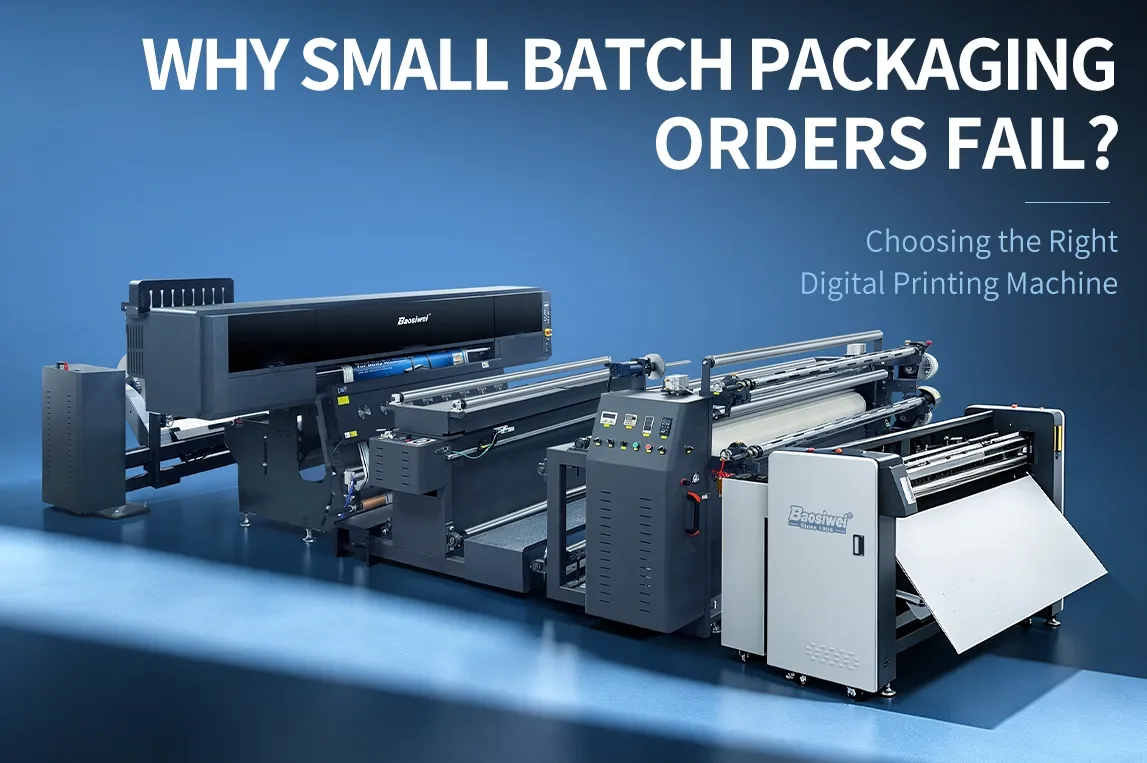
Why Are Your Small Batch Packaging Orders Not Profitable? The Problem May Start With Choosing the Wrong Printing Machine
Why Are Your Small Batch Packaging Orders Not Profitable? The Problem May Start With Choosing the Wrong Printing Machine
Many packaging manufacturers are now receiving more small batch orders as market demand continues to change.
The order quantity of each job may not be large, but orders come in continuously, with frequent changes in designs, specifications, and packaging requirements.
This trend has created new opportunities for digital printing, but it has also made equipment selection more complicated.
Today, some low-cost digital printers and modified machines are available on the market for only a few thousand dollars. With printing speeds of around 10–20 square meters per hour, these machines can be useful for sampling and testing.
For sample production and small testing jobs, these machines have their own applications.
However, when a factory plans to use them for long-term production and starts taking daily small batch packaging orders, problems may begin to appear.
Frequent minor failures, occasional downtime, and repeated adjustments may seem like small issues individually. But once they happen during daily production scheduling, the impact is no longer limited to one material batch.
Small batch orders already require careful cost control. If the money saved during equipment purchasing eventually turns into higher labor costs, longer production times, and more difficult delivery management, the original saving may no longer be meaningful.
Many factories struggle to make profits from small batch orders because they confuse “small batch production” with “low-cost production” when choosing equipment.
Low-Cost Equipment Faces Real Challenges When Entering Production
When purchasing a digital printing machine, manufacturers usually compare several factors first: machine price, print quality, and printing speed.
These factors are important, but once the machine enters daily production, its real performance is determined by how reliably it operates.
During sampling, a machine may only work for several hours a day. After completing the sample, it can stop, and occasional adjustments may not affect the overall workflow.
Production is different.
Packaging orders are continuously scheduled. One day may involve a carton packaging order, and the next job may require a completely different design file.
The order volume may not be large, but the machine needs to follow the production schedule consistently.
If the machine frequently requires troubleshooting, operators have to stop production for inspection and adjustment.
A single issue may only take several minutes to solve.
However, when similar problems happen repeatedly, machine downtime, labor involvement, and delayed orders gradually increase.
For small batch production, this impact can be even greater.
A delayed order can affect the following production schedule. Instead of focusing on manufacturing, operators spend more time dealing with machine problems.
Over time, the factory may accept more small orders but generate less actual profit.
Therefore, low-cost equipment is not necessarily unsuitable.
If the main purpose is sampling, testing, and limited customization, it may be sufficient.
But when a machine becomes responsible for regular production, the evaluation criteria must change.
The question is no longer only how much the machine costs, but whether it can operate reliably in a real production environment.
Small Batch Production Still Requires Stable Production Capacity
Many people have a common misunderstanding about small batch orders:
“The order quantity is small, so a slower machine should be enough.”
In reality, small batch production often means more frequent order changes.
Each order may not require a large quantity, but the factory may need to process many different jobs within a limited time.
In this situation, effective production capacity directly affects production costs.
For example, a machine with a speed of 20㎡/h can theoretically produce around 160㎡ in an 8-hour working day.
A high-speed industrial machine with a speed of 300㎡/h can achieve much higher daily output under the same working schedule.
The production capacity difference directly affects cost calculation.
Labor, factory space, and equipment depreciation do not disappear because order quantities become smaller.
When a machine produces fewer finished products within the same working time, these fixed costs become more difficult to spread across each product.
Therefore, small batch production does not require the cheapest machine.
It requires equipment that matches the factory’s actual order volume and production rhythm.
Baosiwei 8-Head, 16-Head, and 24-Head Digital Printers Match Different Production Needs
Baosiwei does not believe every factory producing small batch orders should immediately choose the highest-speed equipment.
Different factories have different order volumes, production schedules, and growth stages. Equipment selection should match actual requirements.
Baosiwei provides 8-head, 16-head, and 24-head configurations to cover different production needs, from flexible small-scale production to higher-efficiency industrial manufacturing.
The difference is not simply the number of printheads.
From the beginning of equipment design, different configurations are developed with matching solutions for material feeding, printing efficiency, drying systems, and production requirements.
For packaging production, the entire workflow needs to be connected smoothly:
Feeding → Printing → Auto Alignment → Lamination → Cutting → Finished Product
A more integrated production process can reduce unnecessary material handling and transfer between different machines, improving production efficiency and reducing manual intervention.
For factories with limited order volume, an 8-head digital printer may already meet production requirements.
As production demand increases, a 16-head configuration can provide higher efficiency.
When order volume and delivery requirements continue to increase, a 24-head industrial printer can demonstrate its value.
Professional equipment should handle the work it is designed for.
There is no need for every factory to invest in the highest-capacity machine.
At the same time, using a low-capacity sampling machine as a long-term production system can create unnecessary production pressure.
Digital Printing Equipment for Packaging Should Be Designed Around Real Production Needs
Baosiwei packaging digital printing equipment is developed based on real production requirements from the packaging industry.
For packaging manufacturers, the most important factors are not only printing speed.
Material feeding stability, long-term machine operation, consistent color output, and smooth connection with lamination and cutting processes all directly affect production results.
That is why packaging printing equipment cannot be designed only around printing parameters.
A production machine must handle daily manufacturing tasks, not just occasional sample printing.
This is also why Baosiwei develops different configurations from 8-head to 24-head systems.
The goal is to match the machine with the customer’s actual order volume, production plan, and future development needs.
24-Head High-Speed Digital Printer for Higher Production Requirements
For packaging manufacturers with higher production demand, Baosiwei’s 24-head packaging digital printer can reach speeds of up to 300㎡/h, with a daily production capacity of up to 2,400㎡.
This type of equipment has already been applied to carton packaging production.
For factories handling larger order volumes while also managing different designs and small batch requirements, higher production capacity provides more flexibility.
However, a 24-head machine is not the right choice for every factory.
If current production demand is limited, an 8-head or 16-head configuration may be more suitable.
When production schedules become heavier and delivery requirements become stricter, a high-speed 24-head system can provide greater advantages.
For large-volume, long-run packaging orders, traditional offset printing can still be an effective choice.
Digital printing and offset printing should work according to different order structures.
Offset printing is suitable for large-volume production, while digital printing is more suitable for short runs, customized orders, and frequent design changes.
Using the right production method for the right order type helps factories achieve better overall profitability.
When Buying a Digital Printing Machine, Do Not Compare Only the Purchase Price
Machine price is the easiest factor to compare.
However, the real evaluation should include equipment configuration, production capability, stability, and long-term operating costs.
Some machines reduce selling prices by using lower configurations or unsuitable combinations.
The initial purchase cost may look attractive, but during production, maintenance, downtime, labor involvement, and reduced efficiency can become additional costs.
Before choosing equipment, manufacturers should first evaluate:
- How many orders are received every day?
- How much printing volume is required?
- How many hours will the machine operate daily?
- Are small batch orders occasional, or already becoming a stable business model?
- Is future order growth expected?
After understanding these factors, choosing between 8-head, 16-head, and 24-head equipment becomes much clearer.
Small batch orders can have small quantities, but equipment reliability cannot depend on luck.
Baosiwei provides different digital printing solutions from 8-head to 24-head configurations, helping packaging manufacturers select equipment based on their actual production requirements.
Small batch production does not require the highest capacity machine.
But once it becomes a long-term production business, a sampling machine should not be expected to perform like an industrial production system.
The final decision should always return to the real factory environment.
Choose the right capacity. Choose the right equipment.
This is the foundation for making small batch packaging production truly profitable.