When Should an Offset Printing Business Invest in Digital Printing? A Packaging Printer Shares His Experience
When Should an Offset Printing Business Invest in Digital Printing? A Packaging Printer Shares His Experience
Short-run orders are becoming more common. Should traditional offset printing businesses invest in digital printing equipment?
For print shops that have relied on offset printing for years, this is more than an equipment purchasing decision. Customers increasingly need smaller quantities, more designs, and shorter turnaround times. Under a conventional offset workflow, these jobs can be difficult to handle profitably because of plate-making, setup, and production costs.
Mr. Li, an experienced packaging printer, originally built his business around offset printing. He later invested in Baosiwei digital packaging printing equipment to handle short-run color box orders. Over the following years, his order mix changed significantly. He also began taking short-run production jobs from other printing companies.
We spoke with Mr. Li about why he made the investment and what he has learned from running both digital and offset printing operations.
When Short-Run Orders Reach 20%–30%, It May Be Time to Consider Digital Printing
Mr. Li has a straightforward way of evaluating whether a printing business should invest in digital equipment: look at the order mix.
If short-run orders account for around 20%–30% of total orders, he believes it may be worth considering a digital printer. The same applies to businesses looking for new sources of revenue after a period of limited growth.
He shared an example involving a brand developing new packaging products. A single launch might involve dozens of box designs, but the initial quantity required for each design could be relatively small. Producing all these orders through offset printing can be costly because each design requires its own preparation and setup.
There is another concern. If a print shop cannot handle these small orders, it may have to outsource them to another supplier, risking the loss of the customer over time.
That was one of the reasons Mr. Li invested in a Baosiwei digital packaging printer. He wanted to keep these orders within his own factory. Small, multi-design jobs could be handled digitally, while larger production runs could continue through offset printing.
The investment allowed him to retain his existing offset business while taking on work that had previously been difficult to accommodate.
According to Mr. Li, his business grew several times over the following years as he developed the short-run packaging segment. He now also accepts small-batch production jobs from other printing companies that do not have their own digital printing capacity.
Short-Run Orders Can Lead to Larger Production Contracts
Why has Mr. Li continued to focus on short-run orders?
One reason is the cost of launching new products.
When a brand develops a new product, packaging is part of the initial investment. With offset printing, setup alone can cost several thousand yuan. If a customer needs to test multiple designs at once, the initial packaging expense can reach tens or even hundreds of thousands of yuan.
That is a significant commitment before the product has proven its market potential.
Digital printing gives customers another option. They can start with a smaller packaging run and increase quantities once demand becomes clearer. Based on Mr. Li's experience, the printing cost for some short-run jobs can be as low as tens or hundreds of yuan, or around one to two thousand yuan, depending on the order size and production requirements.
For example, a customer developing dozens of products does not need to order large quantities of packaging for every design from the beginning. They can test the market with smaller runs first. If 10 designs perform well, those products can move into larger-scale production.
The initial packaging orders are produced digitally, while subsequent high-volume orders can be handled by offset printing.
For Mr. Li, the value of a short-run order goes beyond the revenue from that individual job. It gives his factory an opportunity to work with the customer from the early product development stage and potentially secure larger repeat orders as the products gain traction.
How Has Mr. Li's Order Mix Changed?
Mr. Li also shared how his factory's business structure has changed since introducing digital printing.
In the past, approximately 80%–90% of its business came from large-volume orders. Today, large orders account for around 30%–40%, while short-run orders make up approximately 50%–60%.
These figures reflect Mr. Li's own factory experience, rather than industry-wide statistics.
In addition to serving his existing customers, he now takes on short-run packaging jobs from other printing companies. For offset-focused businesses without digital production capabilities, outsourcing smaller jobs can be a practical way to serve customers without investing in additional equipment.
For Mr. Li, digital printing has developed from an additional production option into a separate source of business.
What Does Mr. Li Look for When Buying a Digital Printer?
Buying a printer is only part of the investment. The ongoing production cost also determines whether the business can remain profitable.
Mr. Li pays particular attention to ink consumption. When evaluating a digital printer, he believes buyers should look beyond the machine price and the price per kilogram of ink. Actual ink consumption, print coverage, printing modes, and maintenance supplies all affect the cost per square meter.
A practical approach is to test the files and materials used in everyday production before making a purchasing decision. This gives the factory a more realistic picture of running costs than equipment quotations alone.
After-sales support is another important consideration.
Mr. Li shared his experience working with Baosiwei. When he reports an equipment issue in the morning, an engineer can usually arrive at his factory that afternoon. For urgent problems, the technical team may first provide support through video calls. If the issue cannot be resolved remotely, an on-site visit can be arranged for the following morning.
For a factory with daily production schedules, equipment downtime can affect both current orders and delivery plans. This is why Mr. Li believes buyers should evaluate a supplier's technical response, remote support, spare parts availability, and operator training before purchasing a machine.
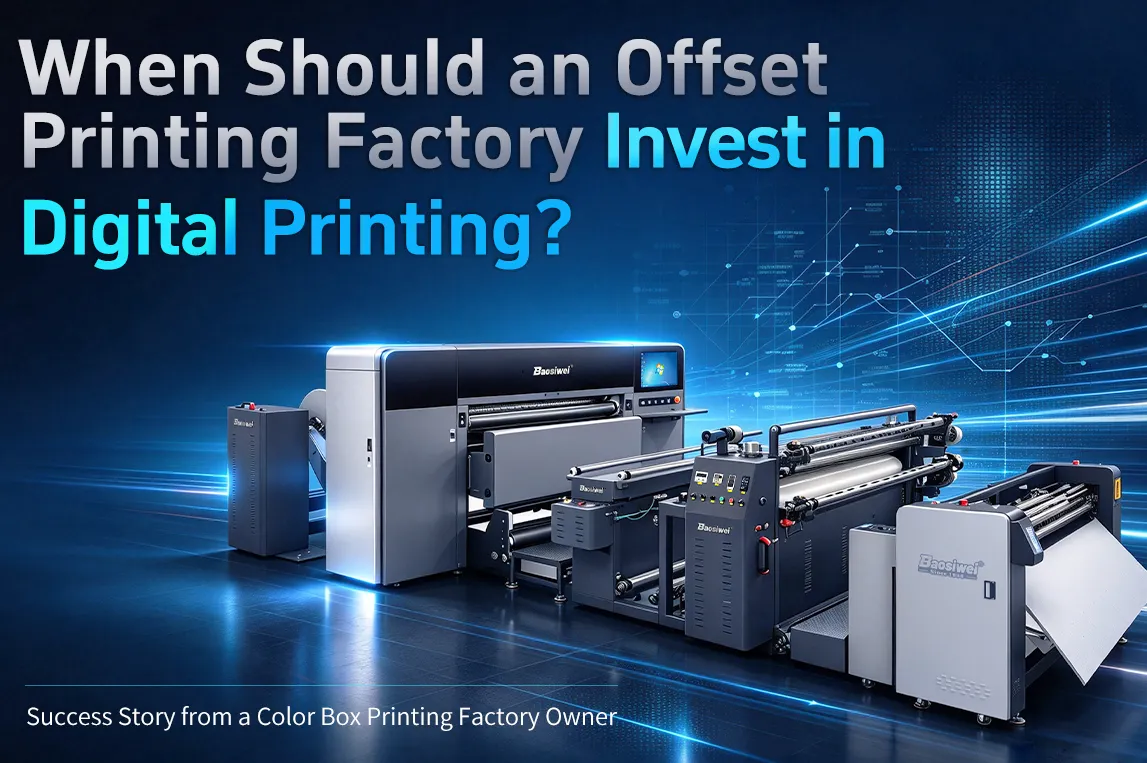
Baosiwei Digital Packaging Printers for Short-Run Production
Mr. Li's experience is one example of how Baosiwei digital packaging printers can be used in short-run packaging production.
Baosiwei offers different printer configurations for common paper packaging materials, including white card, grey-back white board, and kraft paper. Typical applications include fruit boxes, industrial product packaging, appliance packaging, wine boxes, and gift boxes.
Selected models can integrate printing, lamination, and XY cutting into a connected production line, reducing manual material handling between processes. Certain models also support print widths of up to 1.83 meters, making them suitable for larger-format paper packaging applications.
Material compatibility, paper weight, and production configuration depend on the specific machine model and should be confirmed through sample testing.
For offset printing businesses looking to expand into short-run, multi-design packaging production, the right equipment should be selected according to existing order volumes, material types, paper weight, box dimensions, and daily production requirements.
Considering a digital packaging printer for your factory? Contact Baosiwei to arrange a sample test using your own paper materials and packaging files. Our team can help you evaluate print quality, production workflow, and the right equipment configuration for your business.
Website: www.baosiwei.com
Email: [email protected]