
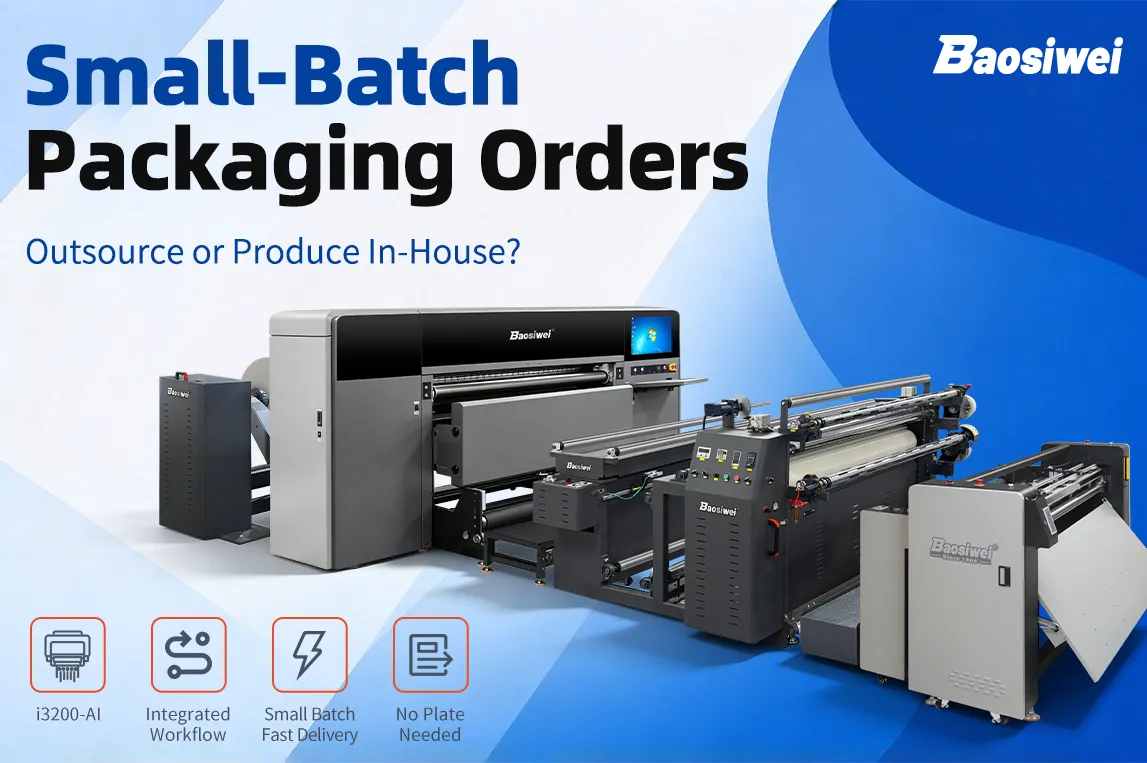
Small-Batch Packaging Orders: Outsource or Produce In-House?
Small-Batch Packaging Orders: Outsource or Produce In-House?
For traditional print shops and packaging converters, outsourcing has long been a practical way to handle orders beyond their existing production capabilities. When a customer requests a small packaging run, a special format, or a job that requires equipment the shop does not have, working with an external supplier can help avoid additional investment in machinery and labor.
However, packaging demand is changing. More customers are requesting short runs, multiple designs, and shorter turnaround times. As these orders become a regular part of daily business, outsourcing may start creating additional costs and making production schedules harder to manage.
This raises an important question for print businesses: Should small-batch packaging orders continue to be outsourced, or is it time to bring suitable printing work in-house with a digital packaging printer?
1. What Challenges Can Packaging Printing Outsourcing Create?
Outsourcing can help print shops manage production capacity, but the actual cost involves more than the processing fee charged by a supplier. File confirmation, communication, transportation, quality inspection, and production coordination also require time and resources.
As small-batch packaging orders become more frequent, these additional demands can put pressure on daily operations.
1. Outsourcing Costs Can Reduce Profit Margins
Traditional offset printing often involves plate making, machine setup, and color adjustment before production begins. For small orders with multiple artwork versions, these preparation costs are difficult to spread across a limited print volume.
Outsourcing may seem like a convenient solution for occasional jobs. However, when small-batch packaging orders become a regular source of business, repeated outsourcing fees can gradually reduce overall profitability.
2. Longer Production Cycles Make Delivery Harder to Control
Packaging production often involves several stages, including artwork confirmation, printing, laminating, cutting, and subsequent finishing.
When printing is handled by an external supplier, the print shop must coordinate production schedules and transportation before moving the job to the next stage.
Last-minute artwork changes, additional quantities, or urgent delivery requests can become more difficult to accommodate when the supplier has its own production schedule.
For orders with tight deadlines, these extra coordination steps can affect the entire delivery process.
3. Quality Control and Production Scheduling Become Less Flexible
Different suppliers may use different printers, substrates, color management systems, and production standards. Without consistent quality control, printed batches may show color variations or surface defects.
Production capacity is another concern. During busy periods, suppliers may prioritize other orders, making it difficult for print shops to secure the production time they need.
Even when a print shop has already confirmed an order with its customer, the external supplier's schedule can still affect delivery.
2. When Should Print Shops Consider Bringing Packaging Printing In-House?
Not every outsourced order justifies purchasing a digital printer. For businesses with occasional demand, unpredictable order volumes, or specialized finishing requirements, outsourcing may remain the more practical option.
However, if the following situations are becoming part of everyday operations, it may be time to evaluate in-house production.
Small-batch orders with multiple designs are becoming more frequent
When customers regularly request dozens or hundreds of packaging units across different artwork versions, the setup and plate-making costs of traditional offset printing can make these jobs less efficient.
A digital packaging printer allows artwork to be changed directly between jobs without conventional plate making, making short-run and multi-design production easier to manage.
Outsourcing fees have become a recurring expense
If your business pays for outsourced packaging printing every month, review the actual costs over a reasonable period.
Consider not only processing fees but also transportation, communication, and order coordination. Comparing these expenses with the total cost of in-house production can help determine whether investing in equipment makes financial sense.
Customers expect faster turnaround times
When customers frequently request urgent replenishment, artwork changes, or shorter delivery schedules, relying on an external supplier can limit your flexibility.
In-house printing gives your team more control over production scheduling and makes it easier to respond to changing order requirements.
You want to offer printing services to nearby print shops
A digital packaging printer can serve more than your own factory's production needs. It can also help you provide short-run, multi-design packaging printing services to nearby traditional print shops.
Potential applications include fruit packaging boxes, appliance packaging, industrial product packaging, and large-format paper packaging.
For businesses with established customer relationships and access to additional orders, this can create another revenue opportunity while improving equipment utilization.
When these requirements develop into a consistent order base, investing in a printer becomes more than adding another machine. It can be a way to restructure production and expand the services your business offers.
3. Improving In-House Production with Baosiwei's 16-Head Digital Packaging Printer
To address the practical requirements of packaging production, Baosiwei has introduced several upgrades to its 16-head digital packaging printing production line this year. The improvements cover machine design, operating convenience, printing performance, and downstream processing.
1. Electrically Adjustable Printing Platform Baffle
The printing platform baffle now features electric height adjustment, allowing operators to adjust it according to production requirements.
This improvement makes daily operation more convenient while giving the machine a cleaner, more industrial appearance.
2. Enhanced Drying System for High-Speed Printing
The drying system has been strengthened to support faster drying during high-speed printing.
This helps reduce the risk of ink smearing, sticking, and other handling issues caused by insufficient drying before subsequent processing.
3. Improved Lamination System for a Cleaner Surface Finish
The lamination system has been further optimized to reduce snowflake-like surface defects during film application.
The result is a cleaner, more even finish that helps improve the appearance of printed packaging materials.
4. Upgraded X- and Y-Axis Cutting Systems
Both the X- and Y-axis cutting systems have been upgraded to circular knives.
Each Y-axis knife is equipped with an independent high-speed motor, helping improve cutting performance, reduce edge burrs, and produce cleaner, more consistent cuts.
5. Better Coordination Across the Production Line
The connection between printing, drying, lamination, and cutting has also been optimized.
After printing, the material can move through the subsequent processing stages with less intermediate handling and fewer repeated manual operations, helping make the overall production process more continuous.
These improvements focus on practical production concerns, including operating convenience, ink drying, lamination quality, and cutting performance. They help packaging businesses establish a more capable in-house printing workflow.
4. In-House Production or Outsourcing: How Should You Decide?
Bringing packaging printing in-house does not mean eliminating outsourcing altogether.
For many traditional print shops, a more practical approach is to divide production according to order characteristics. Jobs with stable demand and suitable digital printing requirements can be handled internally, while occasional orders involving specialized processes can remain outsourced.
Before investing in equipment, evaluate the following cost factors:
| Evaluation Factor | What to Consider |
|---|---|
| Outsourcing Costs | Monthly processing fees, transportation, and additional coordination expenses |
| Equipment Investment | Printer purchase, installation, and depreciation |
| Daily Production Costs | Substrates, ink, electricity, and labor |
| Equipment Utilization | Monthly order volume and actual operating hours |
| Maintenance and Operations | Routine maintenance, consumables, and operator training |
If your business has a consistent order base and can make effective use of the equipment, in-house production may reduce long-term processing costs while improving delivery flexibility.
On the other hand, if order volumes are low or demand fluctuates significantly, continuing to outsource may still be the more economical choice.
The objective is not to eliminate outsourcing. It is to identify which orders are better handled internally and which are more practical to outsource.
Conclusion: Take Greater Control of Packaging Production
The growth of small-batch, multi-design packaging orders is changing how print shops organize production. Outsourcing remains a useful way to supplement capacity, but long-term dependence on external suppliers can limit cost control, delivery flexibility, and business development when these orders become a consistent part of operations.
By introducing a digital packaging printing production line, print shops can retain the advantages of traditional offset printing while adding the flexibility to handle more short-run packaging jobs in-house.
Baosiwei's 16-head digital packaging printer has undergone several upgrades this year, covering the printing platform, drying system, lamination system, and cutting units. These improvements are designed to support a more integrated printing and downstream processing workflow for packaging businesses.
Considering bringing small-batch packaging printing in-house?
Share your substrate type, paper weight, packaging artwork, and expected order volume with Baosiwei. Our team can help evaluate suitable equipment configurations and provide sample testing and production recommendations based on your requirements.
Email: [email protected]
Website: https://www.baosiwei.com