
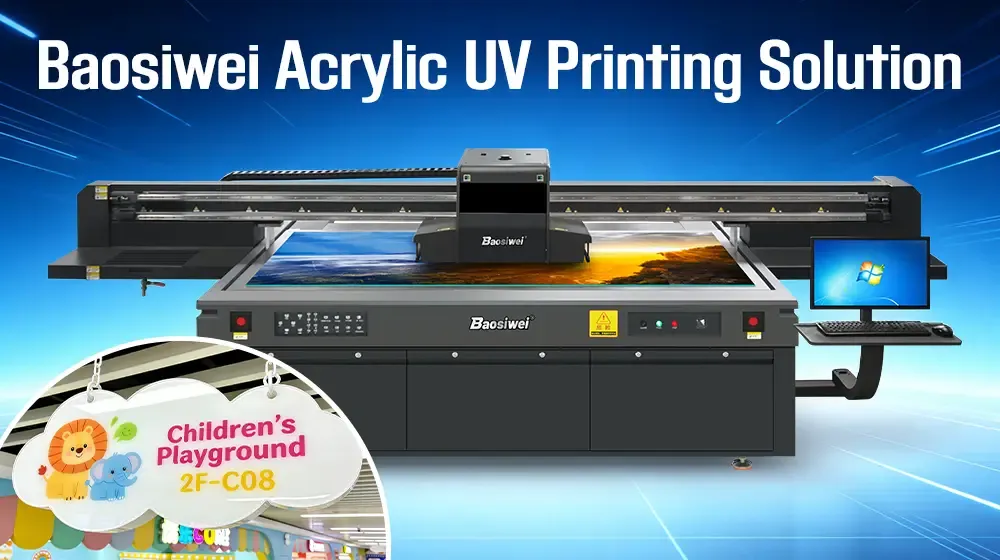
Baosiwei Acrylic UV Printing Solution | Industrial UV Flatbed Printing
Baosiwei Acrylic UV Printing Solution
High-Value Customization and Scalable Industrial Production
Acrylic is one of the most widely used display materials in advertising signage, commercial display, interior decoration, and brand customization. It is also one of the most mature and stable substrates in the display industry today.
As market demand continues to increase for faster delivery times, higher customization flexibility, and consistent batch quality, traditional processes such as screen printing and lamination are gradually showing limitations in efficiency, flexible production, and quality stability. As a result, more and more factories are adopting UV digital printing as a core production process for acrylic products.
In real manufacturing environments, acrylic UV printing is not simply about whether it can be printed or whether the visual result looks good. It is a comprehensive production system involving continuous operation stability, batch consistency control, yield management, process repeatability, and long-term cost efficiency. Different machine structures, printhead configurations, and process solutions have a direct impact on production efficiency and sustainable delivery capability.
From a factory production perspective, this article provides a systematic analysis of acrylic material characteristics, UV printing processes, application scenarios, equipment selection logic, and quality control requirements. Combined with Baosiwei’s mature industrial UV flatbed printing solutions, it helps manufacturing enterprises build a long-term, scalable, and repeatable digital acrylic production system.
What Is Acrylic and Why UV Printing Works So Well on Acrylic
Acrylic (PMMA), also known as organic glass, is a polymer material that combines visual appeal with excellent processing performance. In the advertising and display industry, acrylic is used across the full application spectrum, from basic signage to high-end commercial displays.
From a UV printing perspective, acrylic offers several inherent advantages:
- High transparency – Light transmittance up to 92%, close to optical glass, ideal for premium visual presentation
- Excellent surface flatness – Stable ink droplet placement, suitable for high-resolution output
- Strong weather resistance – Resistant to yellowing and aging, suitable for indoor and outdoor applications
- Good processing adaptability – Can be cut, engraved, polished, and thermoformed for secondary processing
- Wide range of thickness and sizes – From thin sheets to large-format panels, all can be printed stably
These characteristics make acrylic one of the most mature and reliable materials for UV flatbed printing.
How UV Printing Works on Acrylic and Its Core Advantages
UV flatbed printing is a digital printing process in which ink is jetted directly onto the surface of the material and instantly cured by UV LED lamps. The ink solidifies immediately after printing, without natural drying or secondary processing.
For acrylic production, this brings several practical advantages:
• No plate making – ideal for multi-design, small-batch, customized orders
• Short delivery time – products can proceed to the next process or be shipped immediately after printing
• High batch consistency – suitable for repeat orders
• Flexible processes – supports white ink, varnish, and multi-layer structures
This is why more and more advertising factories, display prop manufacturers, and cultural and creative product factories are adopting acrylic UV printing as a core production technology.
Practical Application Scenarios of Acrylic UV Printing
In real commercial applications, acrylic UV printing has become a mature and widely adopted solution, commonly used for:
- Advertising signage, wayfinding systems, shopping mall signboards
- Commercial display stands, POP displays, window displays
- Corporate image walls and brand culture walls
- Trophies, awards, souvenirs, and customized ornaments
- Restaurant menu boards, hotel decorative panels, interior decorative elements
With CMYK + white ink + varnish combinations, acrylic can achieve visual effects far beyond traditional screen printing, including:
- High color saturation
- Multi-layer image depth
- 3D embossed textures and tactile surfaces
- Local gloss and matte contrast effects
These visual effects are the key reasons customers are willing to pay a premium for acrylic products.
Front Printing vs Reverse Printing: Choosing the Right Acrylic UV Printing Process
In acrylic UV printing, process selection is often more important than machine specifications. The two most common methods are front printing and reverse printing.
Front Printing
UV ink is printed directly onto the front surface of the acrylic.
Features:
• Enables obvious 3D embossed effects
• Supports varnish layering for enhanced texture
• Strong tactile feel and visual impact
Typical applications:
Brand logos, signage, door plates, decorative panels emphasizing texture
Reverse Printing
UV ink is printed on the back side of transparent acrylic and viewed from the front.
Features:
• Maintains the original smooth acrylic surface on the front
• The printed image is protected by the material itself and is more scratch-resistant
• Creates strong depth and transparency effects
Typical applications:
High-end display panels, commercial space decoration, brand image walls
Selection recommendation:
If tactile texture and 3D effects are the priority, choose front printing.
If durability and premium visual quality are the priority, choose reverse printing.
The Best Acrylic UV Printers for Factory Production: Matching Real Manufacturing Needs
Baosiwei Recommended Models for Factory Production
A3 UV Flatbed Printer
Suitable for: personalization, startup projects, small-batch high-value products
JW-6090UV Flatbed Printer
Suitable for: small and medium format batch production, balancing customization and efficiency
JW-2513UV Flatbed Printer
Suitable for: high-precision, large-format, continuous industrial production factories
Choosing an acrylic UV printer is not about selecting the highest specifications, but about selecting the model that best matches your order structure.
- Key evaluation factors typically include:
- Maximum panel size for daily production
- Whether orders are mainly small batches or continuous mass production
- Priority between printing accuracy and production speed
- Future capacity expansion plans
Key Factors That Determine Acrylic UV Printing Quality
In real production, problems are often not caused by the machine itself, but by insufficient control of operational details.
Key factors include:
- Panel surface cleanliness – dust and oil contamination cause white spots and graininess
- Distance between printhead and material – too high or too low affects image sharpness
- Adhesion treatment – some applications require coating primer
- UV curing parameters – over-curing or under-curing affects long-term stability
- Production environment control – temperature, humidity, and dust directly affect yield
Baosiwei conducts real-material printing tests before delivery to ensure stable machine operation under actual production conditions.
Acrylic UV Printing Is a Long-Term Production System, Not Just a Machine
Choosing the right equipment supplier is equally important. Purchasing an acrylic UV printer is only the beginning of cooperation. Whether your factory can receive timely, effective, and reliable technical support after installation directly determines production continuity and risk control.
Founded in 1996, Baosiwei is a professional manufacturer specializing in the R&D, manufacturing, sales, and service of large-format inkjet printers. We have successfully developed and deployed more than 1,800 application solutions worldwide across multiple industries.
If you are evaluating an acrylic UV printing project, Baosiwei provides professional support services including:
- Free material and sample testing
- Process and equipment solution evaluation
- Factory visits or remote demonstrations
- Application-oriented model recommendations