
Why Are Small-Batch Flexible Packaging Orders So Difficult? The Real Difference Between Traditional Printing and Digital Printing
Why Are Small-Batch Flexible Packaging Orders So Difficult? The Real Difference Between Traditional Printing and Digital Printing
Many flexible packaging factories have experienced the same situation:
A new customer asks about MOQ and sampling costs. After receiving the quotation, their first reaction is usually:
“Why is the sample cost so expensive? Why is the minimum order quantity so high?”
Especially for startups or smaller businesses, it is difficult to accept thousands of dollars in sampling costs and order quantities starting from tens of thousands of bags.
But honestly, this is not simply a pricing issue. It is a reality that comes with traditional flexible packaging production.
1. Why Are Traditional Flexible Packaging Samples Expensive and MOQs So High?
1.1 Gravure Cylinder Costs Are Already Expensive
Most daily chemical flexible packaging uses gravure printing.
This means every single color requires its own metal printing cylinder, commonly known as “plate making.”
Depending on the design complexity, each color cylinder can cost around USD 40–140 or even more.
For example:
If one packaging design contains 6 colors, and each cylinder costs USD 140, the plate-making cost alone reaches USD 840.
And this is a fixed upfront cost. No matter how many bags are produced later, this expense cannot be avoided.
1.2 MOQ Is Determined by Material Rolls, Not by Factories
Many customers think factories set high MOQs intentionally.
In reality, flexible packaging production is based on roll materials, not individual bags.
Most material rolls on the market are around 8,000–12,000 meters long.
For example:
- Material: PE
- Bag Size: 25 cm
If one material roll is 12,000 meters:
12,000 ÷ 0.25 = approximately 48,000 bags
That is why many packaging factories start with MOQs of tens of thousands.
It is not because they do not want to produce smaller quantities. The material itself is already that long.
1.3 Orders Below MOQ Often Mean Losing Money
Many customers ask:
“Can we produce a smaller quantity?”
But for packaging factories, small orders are actually more difficult.
Because every order requires a full setup process:
- Changing cylinders
- Replacing pressure rollers
- Ink adjustment
- Color matching
This setup process alone can take more than 3 hours.
If the entire material roll is not fully used, the remaining material often becomes waste. In some cases, material loss can exceed 50%.
Under these conditions, factories are basically operating at a loss.
Sometimes old customers still ask factories for help with small orders, and factories may feel uncomfortable refusing them.
So it is not that factories do not want small orders — in many cases, it is simply not practical.
2. Why Does Traditional Flexible Packaging Sampling Take So Long?
Many people think sampling is simply “printing a bag,” but the actual process is much more complicated.
Typically, the workflow looks like this:
(1) Design Confirmation → Plate Making (5–7 Days)
Each color requires its own metal cylinder.
For a standard 4-color package, plate-making costs alone can already reach around USD 560.
(2) Press Setup & Color Adjustment (0.5–1 Day)
Ink colors must be adjusted repeatedly.
If the colors do not match correctly, the process must restart.
Factories also need to:
- Replace cylinders
- Change pressure rollers
- Adjust machine settings
Machine startup itself also creates 15%–30% material waste.
If the design changes midway, both cost and lead time increase significantly.
(3) Finished Sample Production (3–5 Days)
This stage includes:
- Lamination: bonding printed layers, functional layers, and sealing layers
- Curing: placing the laminated material in high-temperature conditions so the adhesive fully reacts (usually 1–3 days)
- Bag Making: sealing, punching holes, zipper installation, etc.
The entire process normally takes 1–2 weeks.
3. Digital Printing Is Changing the Rules for Small-Batch Flexible Packaging
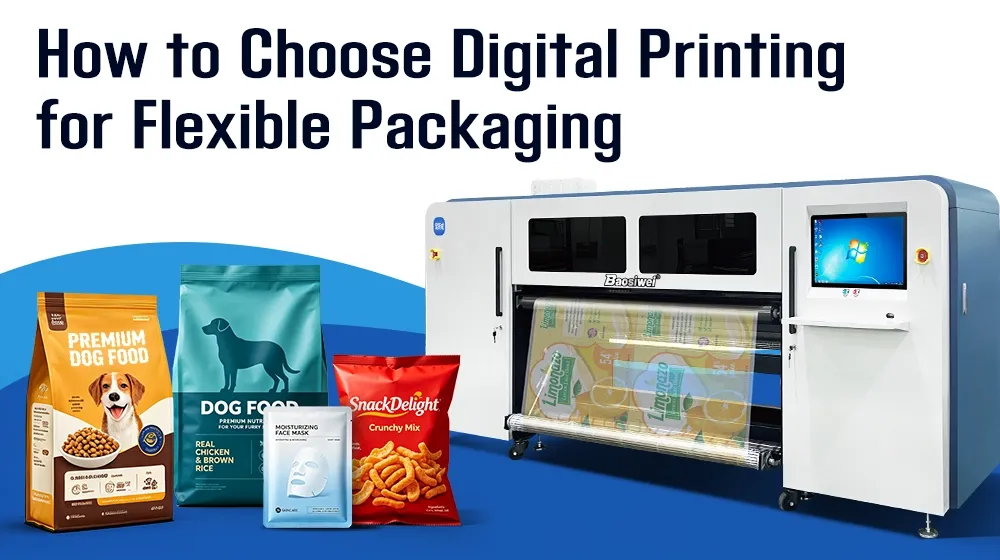
In recent years, more and more customers have started using Baosiwei digital printing solutions for sampling and small-batch flexible packaging production.
The biggest change is actually very simple:
No plate making. Direct printing. Lower cost and faster turnaround.
3.1 The Sampling Process Becomes Much Simpler
The workflow is basically:
- File transfer (online upload)
- Direct printing on OPP or PET film (without plate making)
- Lamination onto packaging material
- Finished product output
Normally, samples and small-batch orders can be completed within 1–2 days.
3.2 No Strict MOQ Limitations
Traditional printing only becomes economical when the full material roll is used.
Digital printing works differently — costs are based on the actual printed quantity.
This means:
- 100 bags is possible
- 500 bags is possible
- 1,000 bags is also possible
Customers are no longer trapped by MOQs of tens of thousands.
3.3 More Flexible Color Printing
With traditional printing, every additional color requires another cylinder.
Digital printing allows all colors to be printed at once.
Gradients, fine details, and color transitions also appear more natural.
3.4 Better for Today’s Small-Batch, Multi-SKU Market
Today, many customers need:
- Multiple SKUs
- Small production runs
- Fast market testing
Traditional printing struggles with this type of demand.
Digital printing helps fill this gap and also creates new business opportunities.
3.5 Seamlessly Integrates with Existing Production Processes
Many people do not realize this at first.
Digital printing is not a completely separate production line.
It can directly integrate with traditional flexible packaging post-processing workflows.
Simply put:
It only replaces the “plate making + printing” stage with digital printing.
The following processes remain unchanged:
- Lamination
- Curing
- Bag making
Factories do not need additional post-processing equipment or major workflow changes.
This is important because:
- Existing production lines can still be used
- Production schedules are not disrupted
- Only the front-end time and costs are reduced
From an investment perspective, it is a much safer and lower-risk upgrade path.
4. A Very Common Strategy: “Digital First, Traditional Later”
Many customers initially worry about investment costs.
But in practice, many businesses now follow this approach:
Step 1: Use digital printing for small-batch testing
Step 2: Once sales increase, switch to gravure printing for mass production
The advantages are obvious:
- No need to hold large amounts of inventory
- Packaging designs can still be adjusted while selling
This approach is often much safer for growing brands.
5. Final Thoughts
If you only look at pricing, flexible packaging may seem expensive.
But when you break down the entire process, the reality becomes clear:
Traditional printing is designed for large-scale production.
Digital printing solves a different problem:
It makes small-batch orders and fast sampling possible.
The two are not replacements for each other — they complement each other.
If you are currently facing:
- High sampling costs
- Excessively high MOQs
- The need to test the market first
Then digital printing may be a practical transition solution.
Baosiwei already has mature PET and OPP flexible packaging digital printing solutions with proven customer cases.
While maintaining print quality, these solutions also improve efficiency.
Many customers use them specifically for small-batch orders, and some recover their investment in less than a year.
If you are interested in this solution, feel free to contact our team through the inquiry form or by email.