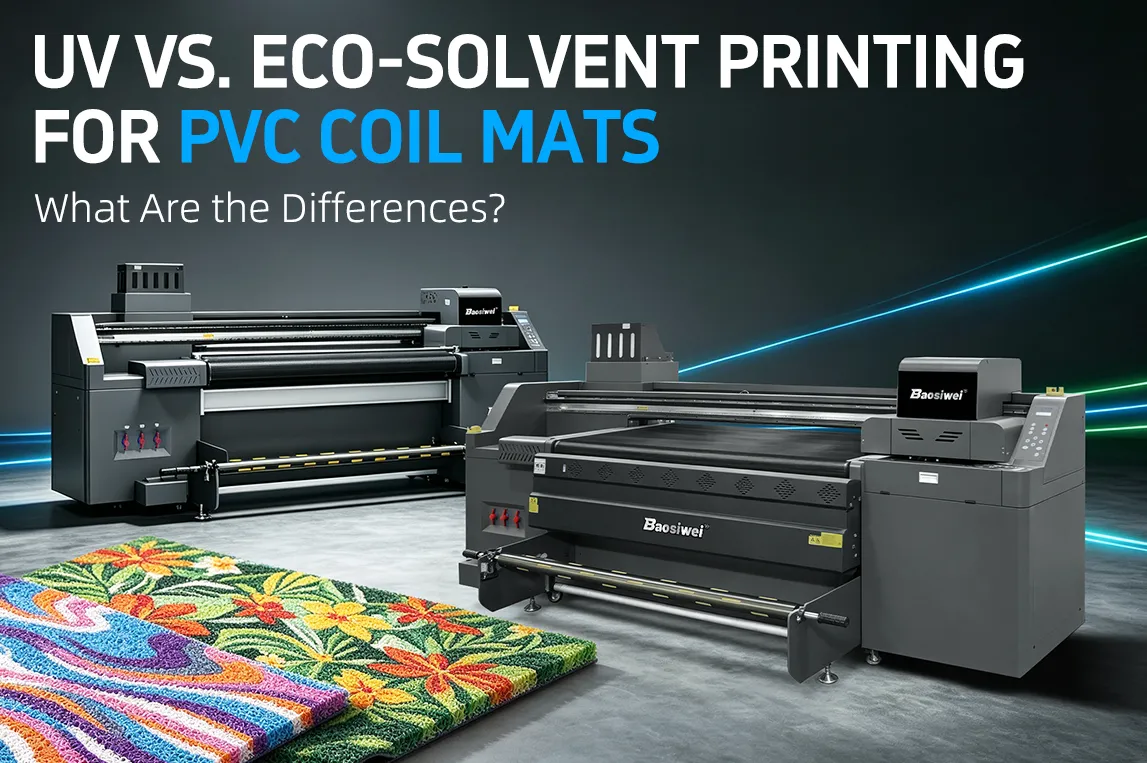
UV vs. Eco-Solvent Printing for PVC Coil Mats: What Are the Differences?
UV vs. Eco-Solvent Printing for PVC Coil Mats: What Are the Differences?
As demand for customized coil mats continues to grow, more mat manufacturers are adopting digital printing to offer a wider range of designs and colors. Today, UV printing and eco-solvent printing are two commonly used methods for printing on PVC coil mats. Each has its own characteristics in terms of ink technology, print quality, production methods, and suitable order types.
In this article, we compare UV and eco-solvent printing for PVC coil mats, explain how the two technologies differ, and explore which printer is better suited to different production requirements.
1. UV Printing for PVC Coil Mats: Fast Curing for Customized Orders
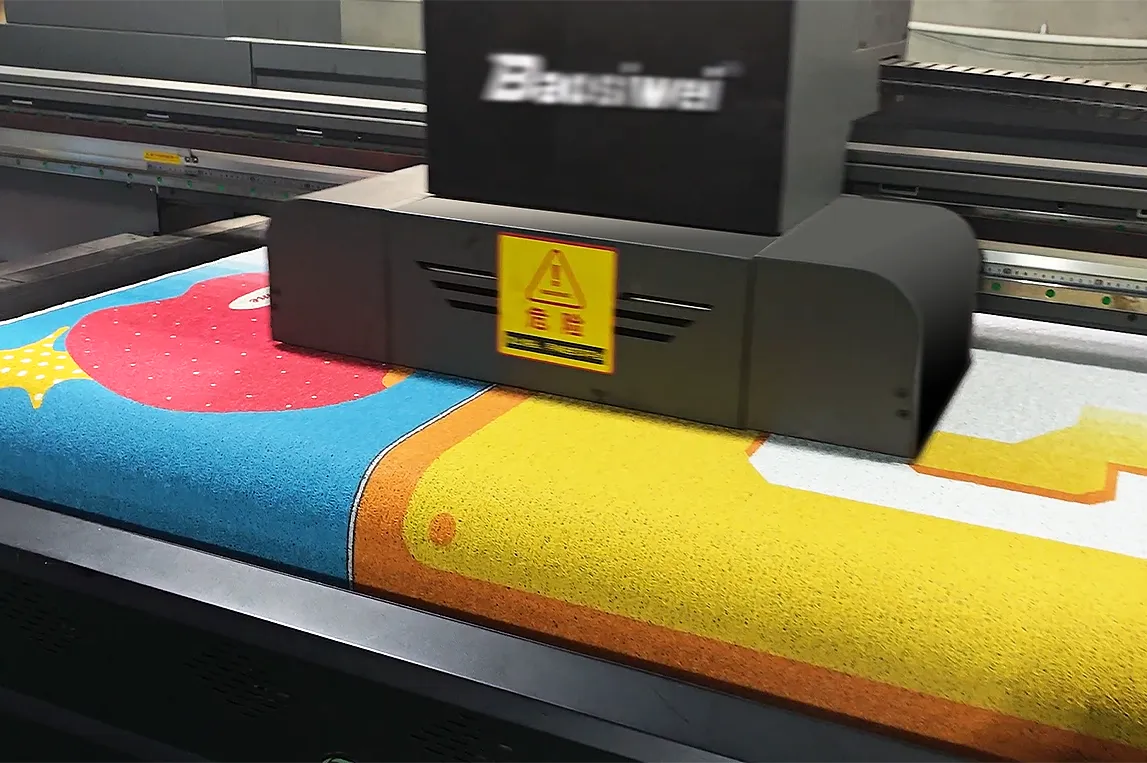
UV printing uses UV-curable ink. The printheads deposit ink onto the surface of the mat material, where it is quickly cured by ultraviolet light, forming a solid ink layer.
One of the main advantages of UV printing is its fast curing process. Once the ink is fully cured, the printed mats can move directly to subsequent processes such as packaging, significantly reducing the waiting time associated with conventional drying methods.
UV printing can also use white ink as a base layer before applying CMYK colors. This helps produce brighter, more vibrant prints, making it suitable for products where visual impact is a priority.
Depending on the form of the PVC coil mat material, two types of UV printers can be used.
1.1 UV Flatbed Printer: For Pre-Cut Mats and Small-Batch Customization
If the PVC coil mat material has already been cut to the required size, a UV flatbed printer can print directly onto each piece.
This method is suitable for customized products such as car floor mats, entrance mats, and mats featuring branded logos.
The printer reads digital design files directly from a computer. No printing plates are required, and even a single piece can be printed. Designs can be changed easily, making this solution ideal for small-batch orders with multiple designs.
1.2 UV Hybrid Printer: For Continuous Roll-to-Roll Printing
For uncut PVC coil mat material supplied in rolls, a UV hybrid printer is a suitable option. The material is fed from the roll and transported through the machine by a conveyor belt for continuous printing.
UV hybrid printers are better suited to orders requiring a certain production volume. They also support computer-controlled printing, allowing operators to switch designs and orders simply by loading a different digital file, without the need for traditional plate making.
The main difference between UV flatbed and UV hybrid printers lies in material format and production method. Flatbed printers are designed for pre-cut mats and customized jobs, while belt printers are designed for continuous printing on roll materials.
2. Eco-Solvent Printing for PVC Coil Mats: Strong Adhesion for Bulk Production
Eco-solvent printing uses eco-solvent pigment inks. During printing, the ink wets compatible PVC materials and forms a good bond with their surface structure. The solvent then gradually evaporates, allowing the printed image to dry.
Compared with UV printing, one notable advantage of eco-solvent printing on PVC coil mats is ink adhesion. Based on the actual production experience of Baosiwei customers, eco-solvent printing delivers better ink adhesion and resistance to repeated foot traffic on PVC coil mats. This makes it a suitable choice for mats designed for long-term use.
In terms of color performance, eco-solvent printing can reproduce a wide range of colors and detailed designs. However, UV printing has an advantage in color vibrancy because it can use white ink as a base layer.
If a product requires especially vivid colors and strong visual impact, UV printing has an advantage. If adhesion and resistance to repeated foot traffic are the main priorities for PVC coil mats, eco-solvent printing is worth considering first.
Eco-solvent inks also generally have a milder odor than traditional strong-solvent inks. However, the actual working environment should still be evaluated based on the ink formulation, relevant test results, and workshop ventilation.
Eco-solvent hybrid printers are primarily designed for mat manufacturers with bulk production requirements.
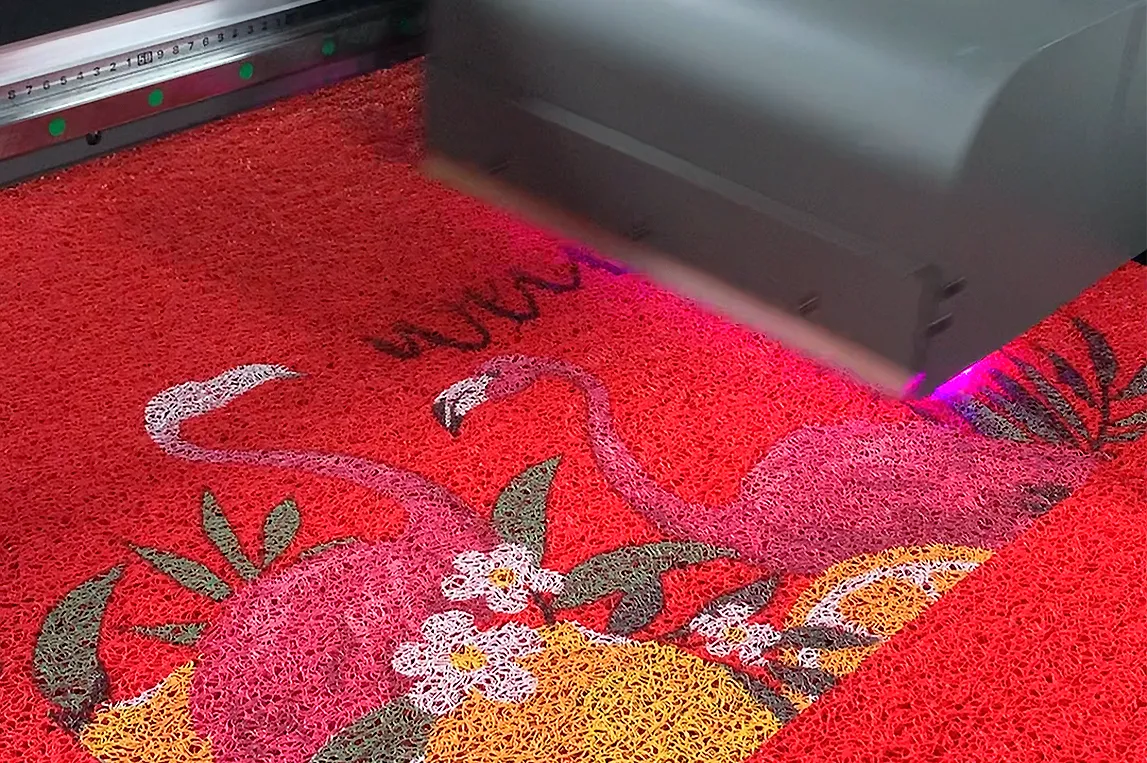
Using continuous roll feeding, these machines are suitable for long production runs of PVC coil mats. For example, Baosiwei's 8-head eco-solvent belt printing solution can achieve an actual production output of over 100 m² per hour. Actual output depends on the print mode, image coverage, and production conditions.
For factories handling larger order volumes, multiple printers can be configured to work together and increase overall production capacity. Digital printing also eliminates the need for printing plates. Operators can switch design files directly from a computer, making it easier to handle orders with multiple designs.
3. UV vs. Eco-Solvent Printing: Which Should You Choose?
Both printing methods have their own advantages. The right choice depends on product requirements, material format, and order volume.
| Comparison | UV Printing | Eco-Solvent Printing |
|---|---|---|
| Ink technology | UV light curing | Solvent evaporation and drying |
| Color performance | White ink underbase available for more vibrant colors | Rich color reproduction, but generally less vibrant |
| Ink adhesion | Depends on ink formulation, material compatibility, and curing | Better performance reported by Baosiwei customers |
| Resistance to foot traffic | Depends on ink formulation, material compatibility, and curing | Better performance reported by Baosiwei customers |
| Drying process | Fast UV curing | Requires sufficient solvent evaporation and drying |
| Printer types | UV flatbed printer, UV belt printer | Eco-solvent belt printer |
| Main applications | Customization, multiple designs, and roll-to-roll printing | Bulk PVC coil mat production |
Here are some practical recommendations for different types of manufacturers:
Custom Mat Manufacturers: If your business mainly produces pre-cut mats in small quantities with multiple designs, a UV flatbed printer is a suitable choice.
Roll Material Processors: If you work with roll materials and need to switch designs frequently while maintaining continuous production, consider a UV belt printer.
Large-Scale Mat Manufacturers: If your main products are PVC coil mats and you handle larger orders, with a greater focus on ink adhesion, resistance to foot traffic, and production efficiency, an eco-solvent belt printer is worth prioritizing.
4. Baosiwei Digital Printing Solutions for PVC Coil Mats
Baosiwei provides three digital printing solutions to meet different PVC coil mat production requirements: UV flatbed printing, UV belt printing, and eco-solvent belt printing.
UV Flatbed Printer: Designed for pre-cut PVC coil mats. It supports single-piece printing and customized designs, making it suitable for small-batch production.
UV Belt Printer: Designed for roll materials. It supports computer-controlled printing and flexible design changes, making it suitable for continuous production and multiple-design orders.
Eco-Solvent Belt Printer: Designed for large-scale PVC coil mat production, offering good ink adhesion and resistance to repeated foot traffic. Baosiwei's 8-head solution can achieve an actual production output of over 100 m² per hour, while multiple machines can be configured to support the production requirements of larger mat factories.
From printer configuration and ink selection to installation, commissioning, and operator training, Baosiwei provides solutions based on each customer's materials, order volume, and production capacity requirements.
If you are looking for digital printing equipment for PVC coil mats, contact Baosiwei and send us your actual production materials for a print test. Our team can help you identify the most suitable printing technology and equipment based on your material characteristics, product requirements, and production volume.