
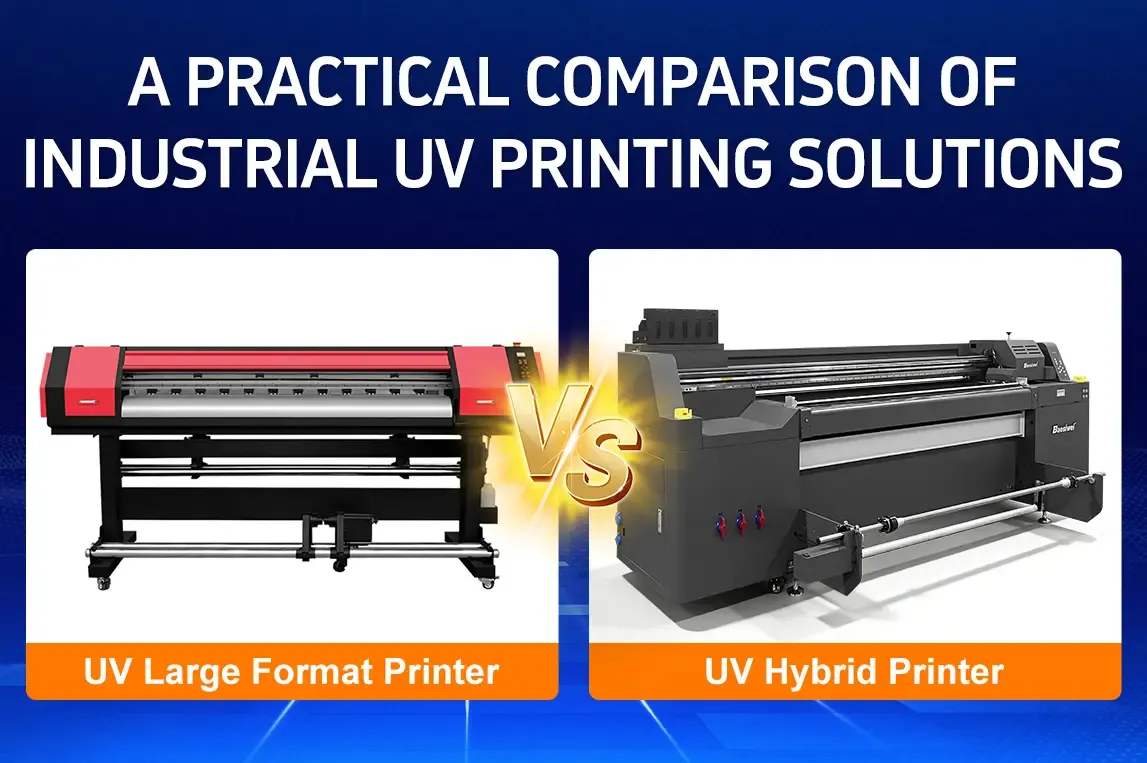
UV Large Format Printer vs UV Hybrid Printer | Industrial UV Printing Comparison
UV Large Format Printer vs UV Hybrid Printer
Key Differences in Industrial UV Printing Systems
Introduction
In recent years, during technical discussions with customers from different countries and regions, we have found a common issue in the equipment selection stage: many users are not fully aware of the core differences between UV large format printers and UV hybrid printers. As a result, confusion often arises when evaluating production solutions.
Although both belong to the category of UV digital printing equipment, their positioning and advantages differ significantly in terms of mechanical structure, production efficiency, material adaptability, and long-term continuous operation stability. These differences directly affect the production model and future business scalability.
Based on real manufacturing requirements, this article provides a systematic comparison between UV large format printers and UV hybrid printers from a production-oriented perspective, helping manufacturers determine which solution better fits their current and future operational needs.
1. Structural Design: Roll-to-Roll Feeding vs Conveyor Belt Transport
UV large format printers typically adopt a roll-to-roll feeding structure. Materials are transported across a fixed printing platform by pressure rollers under controlled tension, making this design more suitable for lightweight and thin substrates.
UV hybrid printers, by contrast, use an industrial conveyor belt system. During printing, materials are supported and continuously transported by the belt, which provides clear advantages when handling heavier or thicker substrates.
The conveyor belt structure offers more uniform material tension and industrial-grade positioning accuracy, significantly reducing the risk of material deviation and print misalignment. This level of stability is essential for long-term continuous production and complex material processing.
In addition, the conveyor belt provides effective heat dissipation during extended operation, allowing heat generated by UV curing lamps and motors to be continuously transferred away from the printing area. This prevents localized heat accumulation and reduces the risk of material deformation.
Baosiwei UV hybrid printers are engineered specifically for feeding accuracy and 24-hour continuous operation. Their industrial conveyor system is designed for high-intensity, long-duration production, making them well suited for large-volume and multi-material manufacturing environments.
2. Printing Speed and Production Capacity
The two printer types also differ clearly in terms of speed and overall production capacity.
UV large format printers are typically configured with one to four printheads and are better suited for small-scale and low-frequency production.
However, due to their fixed printing platform structure, heat generated by UV lamps and drive motors gradually accumulates on the printing table during long continuous operation. For heat-sensitive materials, this can lead to:
- Material warping
- Shrinkage and deformation
- Edge curling
- Surface unevenness
For this reason, UV large format printers are better suited for intermittent, short-run production rather than long-term high-load operation.
UV hybrid printers usually adopt four to eight printhead configurations, delivering higher printing speed and greater output per hour. Their production efficiency aligns more closely with industrial continuous manufacturing requirements.
Because materials move continuously during printing, heat is constantly carried away by the conveyor belt, preventing localized overheating. This makes UV hybrid printers especially suitable for:
- Long-duration operation
- High-frequency batch orders
- Heat-sensitive materials
- 24-hour industrial production cycles
For factories handling large-volume orders and diverse material requirements, UV hybrid printers provide a clear advantage in production capacity.
Baosiwei UV hybrid printers combine multi-head configurations with high-speed conveyor transport, enabling high-throughput production while maintaining consistent print quality and operational stability.
3. Material Compatibility
Material compatibility is one of the most important factors differentiating these two printer types.
UV large format printers are primarily used for small-format, lightweight, and standard advertising materials such as photo paper, PP self-adhesive films, and conventional advertising films. These machines typically require high material flatness and have limited tolerance for thickness variation.
UV hybrid printers offer much broader material adaptability. In addition to most advertising materials, they can also process leather, canvas, soft film, DuPont paper, and other flexible or thick substrates.
With the support of a conveyor belt platform and stable tension control system, UV hybrid printers can reliably handle thin, thick, soft, and elastic media while maintaining high-precision output in complex material applications.
4. Application Scenarios
Due to their relatively compact footprint, UV large format printers are commonly used in:
- Small advertising studios
- Startup print shops
- Indoor signage production
- Posters, photos, and short-run display graphics
UV hybrid printers are more often deployed in large-scale production environments, including:
- Interior decoration industry (wallpaper, tablecloths, glass films)
- Leather processing industry
- Soft film applications in advertising
- Decorative and functional material processing
In general, factories with batch production requirements and complex material portfolios tend to select Baosiwei UV hybrid printers as their core production equipment.
5. Price Range and Target Users
From an investment perspective, UV large format printers typically fall into a lower price range and are suitable for:
- Small studios
- Budget-sensitive users
- Entry-level customers
- Businesses focused on short-run and customized orders
UV hybrid printers are positioned in the mid-to-high price range, depending on configuration. They are better suited for:
- Medium and large enterprises
- Factories with stable order volume
- Production-oriented manufacturers focused on long-term capacity
- Users requiring 24-hour continuous operation
Baosiwei UV hybrid printers are engineered for medium and large manufacturing enterprises, delivering a balanced combination of speed, precision, and long-term stability.
Conclusion: How to Choose the Right UV Printing Solution for Your Business
For small-batch and flexible order environments, UV large format printers remain a practical option. However, once production shifts toward high-frequency continuous operation, equipment stability, heat management, feeding consistency, and sustained output become critical factors.
With their industrial-grade structure, multi-head configuration, and efficient heat dissipation conveyor system, UV hybrid printers deliver stable and efficient production across a wide range of materials and order volumes. They represent the preferred choice for manufacturers pursuing long-term, scalable, and reliable production capacity.
Rational equipment selection should be based on order structure, growth expectations, and production planning over the next one to three years, rather than on initial investment cost alone.
If you are currently facing challenges related to capacity expansion, material diversification, or production stability, our team is available to discuss your specific application requirements.
Baosiwei UV hybrid printers have already helped many factories achieve efficient and stable batch production. Based on your order profile and material needs, we can provide targeted equipment recommendations and production solutions to support sustainable business growth.