
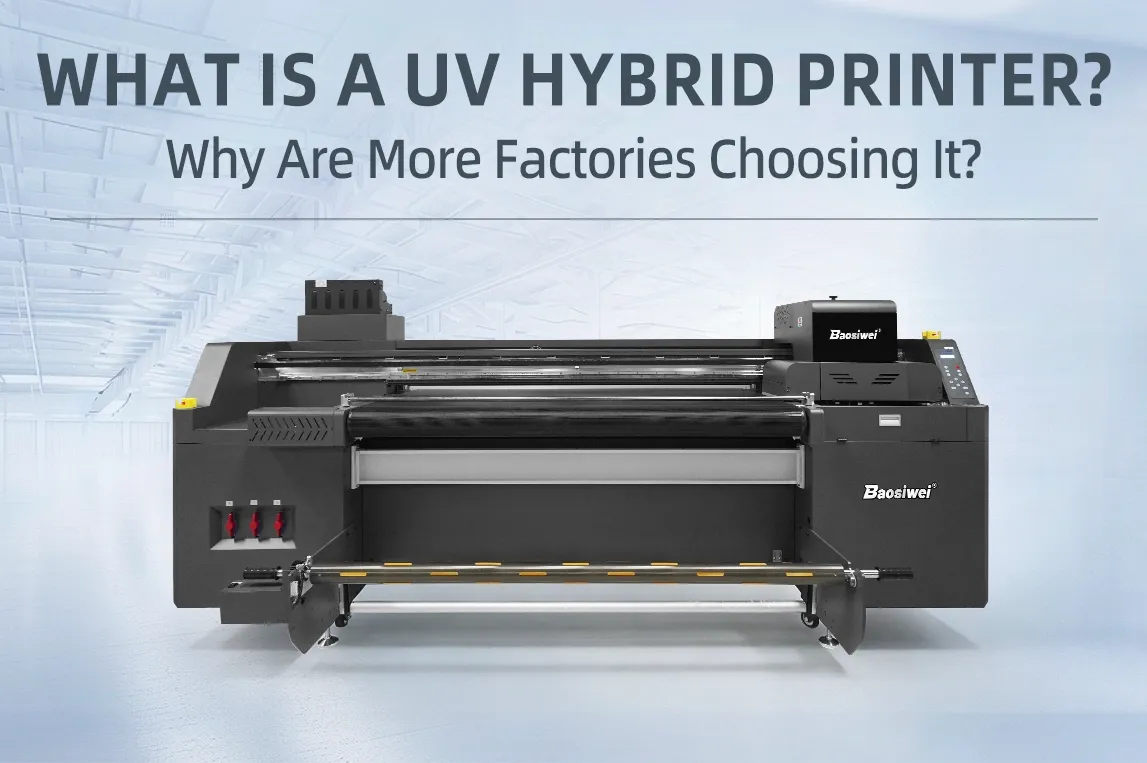
What Is a UV Hybrid Printer? Why Are More Factories Choosing It?
What Is a UV Hybrid Printer? Why Are More Factories Choosing It?
In recent years, industries such as advertising production, home décor, leather products, and new material processing have been going through a major manufacturing transformation.
Traditional production models built around:
- Large-volume orders
- Single SKU production
- Standardized rigid boards
are rapidly being replaced by demand for:
- Small-batch customization
- Fast multi-SKU production
- Ultra-long seamless graphics
- Flexible roll media printing
- Faster delivery cycles
- Greater material compatibility
Traditional static printing systems are becoming increasingly difficult to adapt to these flexible manufacturing requirements.
Against this background, the UV Hybrid Printer has become one of the most important upgrade solutions for modern factories.
Especially in industries such as:
- Wallpaper
- Home décor
- Soft signage
- Artificial leather
- Floor mats and tablecloths
- Decorative roll materials
the adoption of UV Hybrid Printing Solutions is growing rapidly.
Unlike conventional single-purpose systems, a UV Hybrid Printer supports both:
- Flexible roll media
- Selected lightweight rigid materials
which is why it is often referred to as a:
Hybrid UV Printing Solution
Baosiwei industrial UV Hybrid Printers are helping factories:
- Expand business categories
- Improve flexible manufacturing capability
- Reduce labor costs
- Increase production efficiency
through stable industrial-scale production performance.
What Is a UV Hybrid Printer?
A UV Hybrid Printer, also known as a:
- UV conveyor printer
- UV belt printer
- UV conveyor printing system
is an industrial digital printing system specifically designed for:
- Flexible materials
- Continuous production
- Automated industrial manufacturing
The machine combines:
- Industrial-grade printheads
- UV LED instant curing systems
- High-strength Teflon conveyor belts
to achieve:
Continuous feeding + Instant curing + Stable mass production
Compared with traditional UV flatbed printers, UV Hybrid Printers are better suited for:
- Continuous roll production
- Ultra-long graphics
- Flexible media printing
- Multi-SKU customized orders
- Industrial-scale manufacturing
How Does a UV Hybrid Printer Work?
A UV Hybrid Printer operates using:
Fixed Printheads + Continuous Media Feeding
During production:
- The printhead carriage remains stable;
- Servo motors drive the conveyor belt continuously;
- Media moves steadily through the machine;
- UV LED lamps instantly cure the ink after printing.
This workflow enables:
- Continuous material movement
- Instant drying
- Uninterrupted production
- High-efficiency manufacturing
Unlike UV flatbed systems, the media itself moves continuously during production.
This makes the machine ideal for:
- Roll-media production
- Continuous industrial printing
- Ultra-long graphics
Why Are More Factories Choosing UV Hybrid Printers?
1. Better Compatibility with Flexible Materials
Many modern industries now rely heavily on:
- Wallpaper
- Soft films
- Leather
- Fabrics
- Floor mats
- Tablecloths
- Nonwoven materials
Traditional UV flatbed printers often struggle with:
- Flexible media
- Long materials
- Stretchable substrates
which can cause:
- Wrinkling
- Media shifting
- Alignment errors
- Unstable feeding
UV Hybrid Printers solve these issues through:
- Teflon conveyor systems
- Intelligent tension control
- Zoned vacuum adsorption
ensuring more stable flexible-media printing.
2. Seamless Ultra-Long Printing
Traditional flatbed printers are limited by table size.
Large applications such as:
- Wall murals
- Wallpaper
- Soft signage graphics
often require segmented printing and manual splicing.
This can create:
- Visible seams
- Color inconsistencies
- Alignment problems
UV Hybrid Printers support:
Unlimited continuous printing length
making them ideal for large-format decorative applications.
3. Higher Continuous Production Efficiency
Traditional UV flatbed printers operate in an intermittent workflow requiring repeated:
- Loading
- Positioning
- Unloading
UV Hybrid Printers instead use:
Automated production-line workflows
with:
- Automatic unwinding
- Continuous feeding
- Automatic rewinding
allowing:
24-hour continuous production
with production capacity reaching 3–5 times higher than traditional flatbed systems.
4. Ideal for Fragmented Custom Orders
Today’s market increasingly demands:
- Small-batch production
- Multi-design flexibility
- Fast design switching
- Personalized customization
Traditional printing methods involve:
- High plate-making costs
- Slow design changes
UV Hybrid Printers use:
Fully digital inkjet printing
allowing direct production from digital files without plate-making.
This makes them highly suitable for:
- Multi-SKU manufacturing
- E-commerce production
- Fast-turnaround custom orders
5. Hybrid Roll-and-Rigid Production
UV Hybrid Printers support both:
- Flexible roll materials
- Selected lightweight rigid substrates
This allows one machine to serve multiple industries including:
- Advertising
- Home décor
- Leather goods
- Decorative products
- Cultural products
helping factories maximize equipment utilization and shorten ROI cycles.
Main Applications of UV Hybrid Printers
Home Décor
- Wallpaper
- Curtains
- Floor mats
- Tablecloths
- Decorative artwork
Advertising
- Soft-film light boxes
- PVC banners
- Roll-media advertising
- Outdoor graphics
Leather Industry
- PU leather
- PVC leather
- Bag materials
- Footwear fabrics
Customized Products
- Canvas bags
- Nonwoven products
- Personalized decorative products
Conclusion
Competition in today’s digital printing industry is no longer based only on printing precision.
It has become a competition involving:
- Production flexibility
- Delivery speed
- Material compatibility
- Automation capability
- Cost control
UV Hybrid Printers are helping factories transition from:
Traditional static production
to:
Automated continuous manufacturing
If your factory is looking for:
- More stable roll-media printing solutions
- Higher production efficiency
- More flexible small-batch manufacturing
feel free to contact Baosiwei for professional UV Hybrid Printing Solutions tailored to your production needs.