
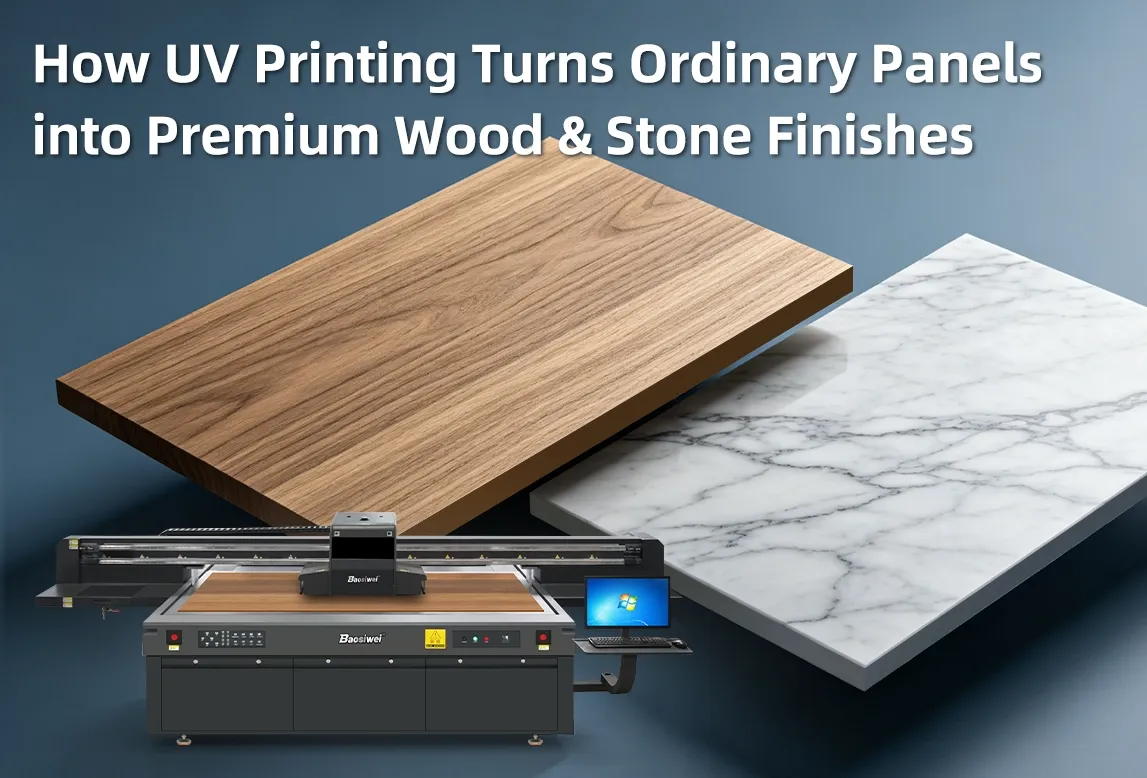
How UV Printing Turns Ordinary Panels into Premium Wood & Stone Finishes
Wood Grain & Stone Texture Printing Made Easy — Turn Ordinary Panels into Premium Wood & Stone-Look Surfaces
As demand for customized interior decoration continues to grow, furniture manufacturers and decorative material factories are facing increasingly diverse order requirements.
Traditional finishing processes for wall panels and furniture surfaces are already highly mature and remain ideal for large-volume standardized production. However, when it comes to small-batch, multi-design customized orders, UV printing technology offers a far more flexible production approach.
01 | Break Material Limits and Customize Textures Freely
One of the biggest advantages of UV printing is its ability to break the limitations between materials and surface designs, giving decorative panel production much greater flexibility.
Whether it is solid wood panels, MDF boards, metal sheets, glass panels, or stone materials, as long as the surface height difference is within 20 mm, direct printing is generally possible.
From popular oak and walnut wood grains to classic marble and Calacatta-style stone textures — or even fully customized artwork provided by customers — everything can be printed directly from digital files. No plate-making and no roller replacement are required, making design switching faster and easier while allowing ordinary panels to achieve a premium decorative appearance.
Compared with traditional veneer lamination or film-coating processes, UV printing essentially frees decorative effects from the limitations of the base material itself.
In the past, many factories had to stock large quantities of veneers and decorative patterns in advance, which increased inventory pressure and capital costs while also making it harder to respond quickly to changing market trends. Today, the focus is shifting from “materials determining the final effect” to “design determining the final effect.”
Factories can now quickly adjust patterns and decorative styles based on customer demand and market trends, reducing inventory pressure while improving order flexibility.
As the home decoration industry increasingly emphasizes personalization and differentiation, this type of flexible production capability is becoming more important than ever.
02 | Simplify Production Processes While Reducing Costs
Traditional decorative manufacturing processes have evolved over many years and remain highly stable and reliable.
Whether it is wood veneer lamination or ceramic tile printing, traditional methods still offer strong advantages in large-scale standardized production. However, when factories begin handling more small-batch, multi-design, fast-turnaround orders, the disadvantages of complicated workflows and high switching costs become more apparent.
Traditional production methods often involve:
- Mold preparation
- Plate-making
- Color adjustment
- Sample testing
- Veneer or film lamination
- Drying and curing
As a result, the overall workflow becomes longer, and design switching takes more time.
With UV printing, the process can be simplified into:
Artwork Processing → Direct Printing → Instant UV Curing
No plate-making is required, and there is no need for additional lamination processes. A single operator can handle the machine efficiently. For sample production, small custom orders, and rapid prototyping, the efficiency advantage becomes especially obvious.
More importantly, UV printing is not only suitable for small-batch customization — it can also support stable continuous industrial production.
For manufacturers, this means:
- Lower trial-and-error costs
- Faster new design development
- More flexible order response capability
- Shorter delivery cycles
In the past, developing a new decorative pattern often required multiple rounds of proofing and confirmation. Today, many factories can complete the entire process from design to finished product within the same day.
As “small orders with fast turnaround” become increasingly common across the market, this production efficiency is becoming a major competitive advantage.
03 | Environmentally Friendly and Suitable for Multiple Applications
As environmental regulations in the interior decoration industry continue to become stricter, the market is demanding higher standards for both sustainability and product durability.
UV printing uses environmentally friendly UV inks and eliminates many traditional high-pollution production steps, making it more compliant with modern environmental requirements.
At the same time, UV printed surfaces offer:
- Wear resistance
- Scratch resistance
- UV resistance
- Stable color performance
These characteristics allow UV printing to adapt to a wide range of applications.
Whether for indoor furniture panels, wall decorations, moisture-resistant bathroom wood textures, commercial interior backgrounds, or even weather-resistant outdoor stone-look signage, UV printing can deliver reliable decorative performance.
It is also important to understand that UV printing is not intended to replace traditional manufacturing processes entirely.
Instead, it serves more as a flexible supplementary production solution.
Factories can choose production methods according to different order types:
- Large-volume standard products continue using traditional production lines
- Small-batch customized products use UV printing solutions
This hybrid production model allows manufacturers to maintain the cost advantages of traditional large-scale production while also meeting the growing market demand for customization and fast delivery.
END
UV flatbed printers are becoming an increasingly valuable supplementary production solution.
On one hand, they help ordinary panels achieve significantly higher added value.
On the other hand, they allow factories to handle small-batch and multi-design orders more flexibly.
As the furniture, interior decoration, and decorative materials industries continue moving toward personalization and product differentiation, manufacturers that can respond faster to market demand will gain stronger competitive advantages.
If you are looking for a flexible panel printing solution that can simplify production while supporting customized orders, feel free to contact Baosiwei. We can provide mature UV printing solutions and arrange sample testing based on different materials and application requirements.