
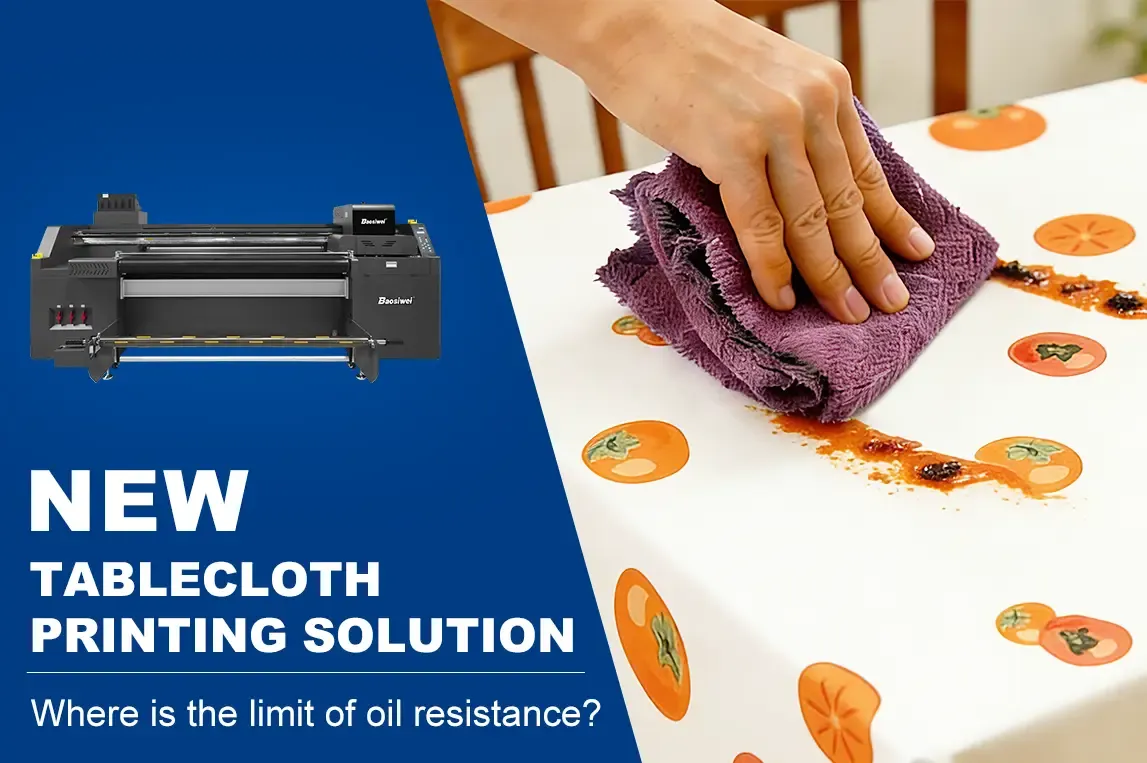
New Tablecloth Printing Solution: Where Is the Limit of Oil Resistance?
New Tablecloth Printing Solution: Where Is the Limit of Oil Resistance?
Factory 24-Hour Chili Oil Soak Test — Wipe Clean, Smooth Like New
Industry Background: Global Foodservice Is Redefining Tablecloth Performance Standards
Across the global restaurant and hospitality industry, tablecloths are no longer just decorative textiles. They are high-frequency functional products used every day.
From five-star hotels to chain restaurants, from home kitchens to banquet dining, the performance requirements are becoming increasingly consistent worldwide:
Water resistance, oil resistance, stain resistance, easy cleaning, high durability, and reusability.
For tablecloth manufacturing factories around the world, this means one thing:
A tablecloth must deliver not only an attractive printed design, but also stable long-term protective performance.
Oil resistance has shifted from a “nice-to-have selling point” to a non-negotiable functional requirement—and it has become a key factor in improving competitiveness for tablecloth factories globally.
The Real Challenges Facing Tablecloth Factories Worldwide
In real production, achieving oil resistance itself is not the hardest part. The real difficulty lies in:
- Once oil resistance requires additional post-processing, the production rhythm is disrupted
- Print quality and protective performance are difficult to achieve at the same time
- Delivery lead time becomes longer due to multiple extra processes
- More machines are required, increasing investment cost and business risk
For local manufacturing factories supplying hotel groups, restaurant chains, or e-commerce platforms, traditional tablecloth processes are increasingly unable to support fast delivery and customized production demand.
Baosiwei’s New-Generation Digital Printing Solution for Tablecloths
Driven by the global tablecloth industry’s need for high performance, high efficiency, and low-complexity production systems, Baosiwei has developed a new-generation digital tablecloth printing solution.
With one single digital printing process, this solution enables:
Pattern printing + Water resistance + Oil resistance + Easy-clean performance
No additional post-processing is required.
No lamination is required.
No coating finishing is required.
This means tablecloth factories can maintain their original production pace, while completing printing and protective functionality at the same time.
Industrial Validation: 24-Hour Chili Oil Extreme Test
In the global linen and table textile industry, oil resistance is not proven by lab numbers alone—it is proven by real-world extreme conditions.
Chili oil, seasoning sauces, animal fats, coffee, and red wine are the most representative high-contamination substances in foodservice environments.
That is why we used an industrial-level testing method, selecting chili oil as the extreme test medium to validate the performance of tablecloths printed with this new solution.
Test Method
Pour high-concentration chili oil directly onto the surface of the printed tablecloth.
Leave it soaked at room temperature for 24 hours.
Test Result
After 24 hours, simply wipe the tablecloth surface with a wet cloth:
The oil stain is completely removed. No penetration. No fiber residue. No color change in the pattern. No fabric damage.
By comparison, tablecloths produced with traditional printing processes but without protective treatment showed obvious oil penetration under the same conditions, and could not be fully cleaned.
The results confirm that this solution can maintain stable protective performance even when exposed to high-oil, high-pigment, high-penetration contamination.
Key Value for Global Tablecloth Manufacturing Factories
From a manufacturing perspective, this solution is not only a product upgrade—it is a systematic optimization of production structure.
Hit Best-Selling Features and Strengthen Product Competitiveness
One process gives the product three high-demand selling points:
Water-resistant, oil-resistant, and easy-clean, making your tablecloths more convincing and more competitive in the market.
Simplify the Process and Speed Up Delivery
By eliminating all post-processing steps, production efficiency improves significantly.
You can respond faster to both offline retail demand and e-commerce orders—especially for fast restocking and high-volume repeat production.
Reduce After-Sales Issues from the Source
Improved durability and easier maintenance help reduce complaints and return rates caused by stains penetrating the fabric, protecting your customer satisfaction and brand reputation.
Expand Applications and Grow Your Business Coverage
Tablecloths produced with the Baosiwei solution are suitable not only for home use, but also meet strict durability and cleaning requirements for hotels, restaurants, cafés, and other commercial environments.
With one production system, you can serve both retail orders and project-based commercial orders, expanding your market reach efficiently.
Conclusion: Tablecloth Manufacturing Is Entering the Functional Integration Era
Tablecloth manufacturing worldwide is moving from “printing production” to “functional production.”
Oil resistance, water resistance, and easy cleaning are no longer optional add-ons. They are becoming the standard configuration for next-generation tablecloth products.
A manufacturing process that can deliver stable protective performance without sacrificing production efficiency will become a core competitive advantage for tablecloth factories in the future.
This is not just a technology upgrade—it is a new-generation digital printing solution built for the future of the tablecloth industry.
If your tablecloth products are facing the same challenges, you are welcome to contact us.
Baosiwei can provide free sample printing and sample delivery, as well as a complete tablecloth digital printing solution and supporting equipment.