
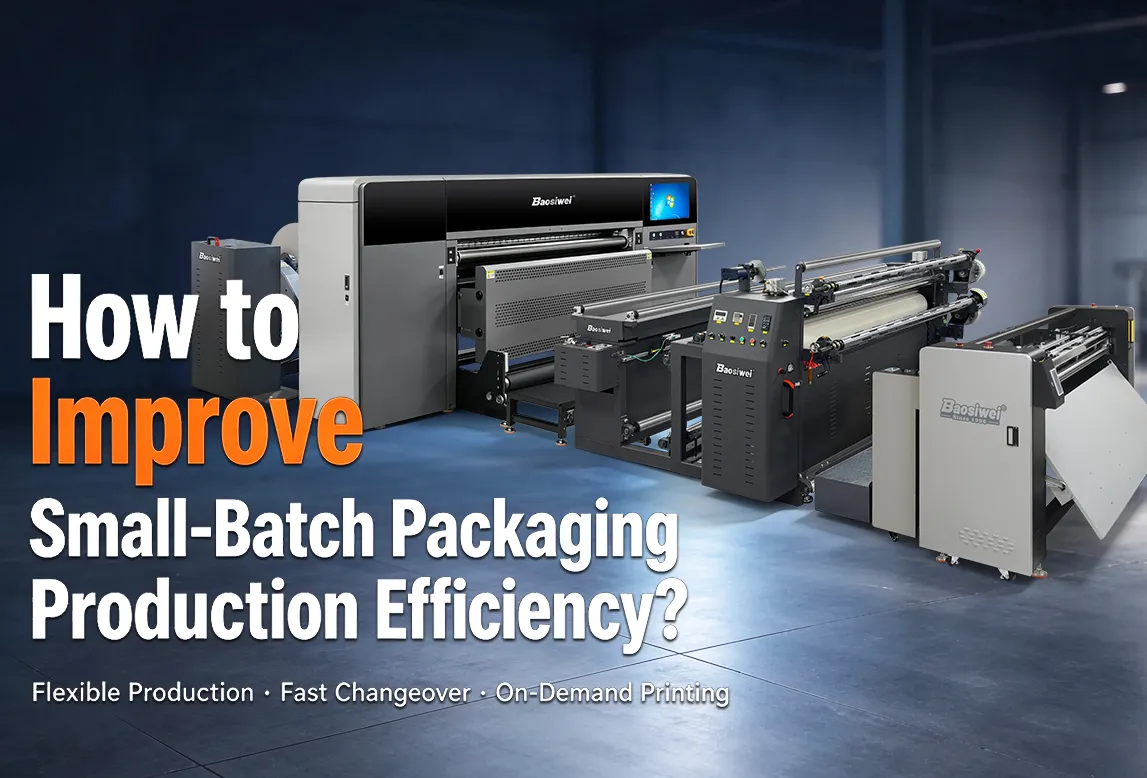
How to Improve Small-Batch Packaging Production Efficiency?
How to Improve Small-Batch Packaging Production Efficiency: An Integrated Digital Printing, Laminating and Cutting Solution
Small-batch packaging orders, shorter delivery times, and an increasing variety of product designs are placing greater demands on packaging manufacturers. Simply increasing printing speed is no longer enough. So, how can packaging businesses improve efficiency when handling small-batch production?
Baosiwei offers an integrated digital packaging printing solution that combines roll feeding, digital printing, inline lamination, and precision cutting into one continuous production process. Designed to improve production efficiency, print quality, and operational stability, the solution helps packaging manufacturers handle diverse orders more flexibly while reducing manual material handling.
1. Why Does Small-Batch Packaging Production Need an Integrated Workflow?
In traditional packaging production, printing, lamination, and cutting are often carried out as separate processes. Materials must be transferred between machines, loaded and unloaded manually, and coordinated across different production stages.
For packaging manufacturers handling small batches, multiple SKUs, and urgent orders, this workflow can create several challenges:
- Longer production lead times: Material transfers, waiting periods, and process coordination all add time to production.
- High labor requirements: Separate operators may be needed for machine operation, material handling, and order checking, increasing labor costs.
- Higher material waste: Frequent loading, unloading, handling, and machine adjustments can result in unnecessary paper and film waste.
- More complicated production scheduling: Frequent changes in designs, sizes, and materials make production planning more difficult.
Baosiwei integrates the key production stages into one streamlined workflow:
Roll Feeding → Digital Printing → Inline Lamination → Precision Cutting
After printing, the material moves directly into the lamination and cutting modules, reducing the need for manual transfers between machines.
This integrated workflow is particularly suitable for packaging manufacturers handling small batches, multiple SKUs, and frequent design changes. It simplifies production coordination and provides greater flexibility when responding to different order requirements.
2. Consistent Packaging Quality from Printing to Lamination and Cutting
For applications such as fruit cartons, gift boxes, and consumer product packaging, print quality and finishing details directly affect the appearance of the final product.
Color accuracy, fine text reproduction, lamination quality, and cutting precision all contribute to the finished packaging result.
Common production issues include color inconsistency, blurred fine text, uneven lamination, and rough cutting edges. To address these challenges, Baosiwei has optimized the printing, lamination, and cutting systems.
2.1 8-Color Printing Configuration for Detailed Image Reproduction
The machine features an 8-color printing configuration designed to deliver a wide color gamut, rich tonal gradation, and smooth image transitions.
Key printing advantages include:
- Fine text and detailed graphics: Sharp edges and clear details, supported by stable ink placement.
- Product photography and complex illustrations: Rich colors and accurate reproduction of image details.
- Large solid-color areas: More uniform ink coverage, helping reduce visible banding and color inconsistency.
- Gradients and multi-tone transitions: Smooth color transitions with fewer visible steps or breaks.
Consistent color output across production batches also helps packaging manufacturers maintain more standardized print quality.
2.2 Optimized Lamination System to Reduce Silvering, Bubbles, and Wrinkles
Lamination enhances the visual appearance of packaging while providing additional protection against moisture and abrasion.
However, uneven film application can lead to bubbles, wrinkles, and silvering defects on the laminated surface. These problems may result in rework, material waste, and rejected products.
Baosiwei has optimized the synchronized material feeding and film-lamination control system to help ensure uniform, close contact between the film and printed paper during continuous operation, reducing common surface defects.
2.3 Upgraded Cutting Module for a Wide Range of Packaging Paper
Cutting precision directly affects subsequent processes such as die-cutting, creasing, folding, and box gluing.
Dimensional deviations or rough cutting edges can cause feeding problems and assembly defects during downstream processing.
The upgraded cutting module is designed to handle commonly used packaging materials, including grey-back white board and white cardboard. It delivers clean, even cutting edges to meet the requirements of subsequent packaging processes.
3. Industrial-Grade Hardware for Continuous Production
For packaging manufacturers, equipment reliability should be evaluated by its ability to maintain stable performance during extended, high-load operation.
Consistent machine performance is essential for meeting delivery schedules and controlling production costs. Baosiwei uses industrial-grade structural components to support demanding production environments.
3.1 Shaftless Unwinding System with a Maximum Paper Roll Load of Approximately 2 Tons
The shaftless unwinding system is designed to handle heavy paper rolls with a maximum load capacity of approximately 2 tons.
Its heavy-duty loading design simplifies roll replacement, reduces downtime during material changes, and helps maintain continuous production.
3.2 Heavy-Duty Lamination Structure with Approximately 1.5 Tons of Structural Counterweight
The machine features a robust frame and reinforced lamination structure, with approximately 1.5 tons of structural counterweight.
This heavy-duty construction helps absorb vibration, maintain smooth material feeding, and reduce the risk of material deviation and uneven lamination during operation.
3.3 Consistent Cutting Performance During Extended Production Runs
The cutting module is calibrated for continuous production, helping maintain consistent cutting quality across extended runs.
By reducing the quality gap between sample production and batch output, the system supports packaging manufacturers transitioning from initial testing to regular small-batch production.
4. Key Benefits of an Integrated Solution for Packaging Manufacturers
When introducing digital printing equipment, packaging manufacturers need to consider how it will fit into their existing production processes and work with downstream finishing equipment.
The following table outlines how Baosiwei's integrated solution addresses common production challenges.
| Key Production Requirements | Benefits of Baosiwei's Integrated Solution |
|---|---|
| Multiple designs, small batches, and urgent orders | No traditional plate making is required. Designs can be changed quickly to respond flexibly to different order requirements. |
| Frequent material transfers between production stages | Roll feeding, printing, lamination, and cutting are connected in one synchronized workflow. |
| High labor requirements and operating costs | Reduces the need for dedicated operators and manual material handling between processes, helping improve labor efficiency. |
| Inconsistent lamination quality | The optimized lamination system helps reduce bubbles, wrinkles, and silvering defects. |
| Different packaging materials and paper weights | Supports commonly used materials, including grey-back white board and white cardboard, within the 80–400 g/m² range. |
| Long production runs requiring stable operation | Industrial-grade heavy-duty construction and a 2-ton shaftless unwinding system support continuous production. |
Note: Actual production efficiency and output quality depend on material specifications, artwork files, cutting requirements, and workshop conditions. Packaging manufacturers should evaluate overall production and delivery efficiency across the entire workflow rather than comparing printing speed alone.
Make Digital Printing Part of Your Everyday Packaging Production
For manufacturers producing fruit cartons, gift boxes, consumer product packaging, and other printed cartons, connecting digital printing with downstream lamination and cutting is an important step toward improving small-batch production efficiency and simplifying order scheduling.
Baosiwei's integrated packaging digital printing solution helps manufacturers streamline multiple production stages, reduce manual handling, and respond more flexibly to changing order requirements.
Want to see how your packaging materials and production requirements perform on an integrated system?
Contact the Baosiwei technical team to arrange a free sample test or discuss a small-batch packaging production solution tailored to your factory.
Email: [email protected]
Website: https://www.baosiwei.com