
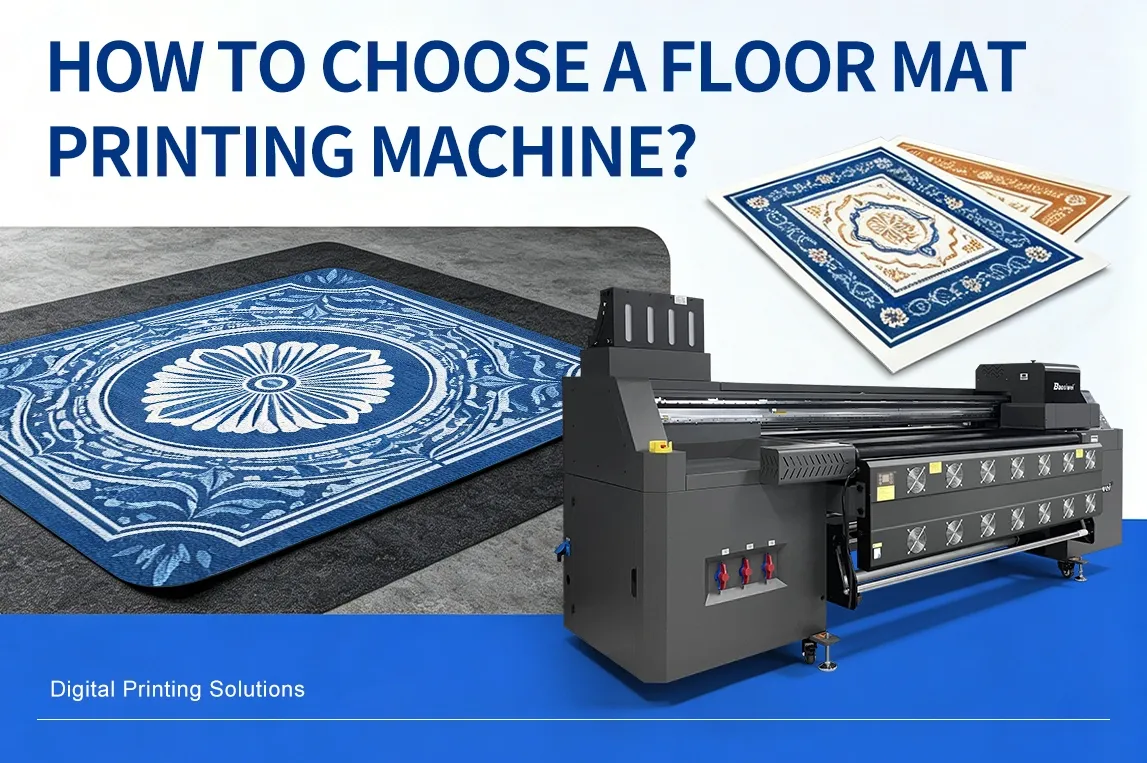
How to Choose a Floor Mat Printing Machine? Most People Make the Same Costly Mistake
How to Choose a Floor Mat Printing Machine? Most People Make the Same Costly Mistake
In recent months, more and more manufacturers and business owners have been asking the same question:
How do I choose the right floor mat printing machine?
To be honest, after more than 10 years in the floor mat printing industry and working with hundreds of factories, we’ve seen one very common pattern:
👉 Most failures are not caused by bad machines, but by a mismatch between equipment and actual production needs.
Some buyers choose flatbed machines for roll materials.
Some use incorrect ink systems for dark-colored loop mats.
Others simply focus on machine price, only to discover that long-term production costs become overwhelming.
Over the years, including many real-world projects we’ve supported (with Baosiwei industrial printing solutions involved in multiple cases), we’ve seen almost every possible mistake.
So in this article, we won’t talk about theory or technical parameters.
Instead, we will walk you through real production experience and practical decision logic.
If you are planning to invest in a mat printing system, this guide is worth reading carefully.
1. Before Choosing a Floor Mat Printer, You Must Understand These 3 Key Factors
Most people start by asking:
“Which machine is the best?”
But the real question should be these three:
1. What material are you printing?
Floor mats come in many materials:
1. PVC loop mats
2. Microfiber / velvet mats
3. Coconut fiber mats
4. Polyester mats
5. Foam PVC mats
6. PU leather mats
Although they look similar, the printing requirements are completely different.
If the material does not match the printing process, you will likely face:
1. Dull and faded colors
2. Weak ink adhesion
3. Color fading after a short period of use
Once these problems occur, they are usually not caused by machine adjustment, but by incorrect system selection from the beginning.
That’s why in Baosiwei solution projects, the first step is always material testing and sample proofing before recommending any machine.
2. Is your product roll-based or sheet-based?
This seems simple, but it directly determines your production system.
- Roll materials → Conveyor printing system
Continuous feeding, high efficiency, suitable for mass production - Sheet materials → Flatbed printing system
Flexible switching, ideal for customized orders and small batches
Many production failures come from choosing the wrong system at this stage.
3. Have you calculated the real production cost?
Most buyers focus only on machine price.
But in real production, cost structure is far more important:
1. Ink and consumable cost
2. Labor efficiency
3. Machine stability and downtime risk
4. After-sales support and maintenance speed
In many real cases, low-cost machines lead to higher total production cost due to frequent downtime and consumable inefficiency.
This is something we often see in real Baosiwei-supported production projects.
2. 4 Main Floor Mat Printing Solutions in the Industry
Once the basics are clear, choosing a system becomes much easier.
Currently, there are four main mature production solutions in the market.
UV Conveyor Printing System: Ideal for High-Volume Roll Production
UV conveyor systems are widely used because of their strong compatibility.
They can handle:
1. Loop pile mats
2. Microfiber mats
3. PVC foam mats
4. PU leather mats
Key advantages:
1. Simple production workflow
2. Bright and saturated colors
3. Instant drying, no post-processing
4. Stable continuous output
Production capacity is typically around 90㎡/hour.
👉 Best for: Factories focusing on bulk production and fast delivery cycles, especially during peak seasons.
Eco-Solvent Conveyor System: Ideal for Light-Colored Mats
Eco-solvent systems focus on ink penetration rather than surface coating.
Key features:
1. Ink penetrates into the material structure
2. High durability and abrasion resistance
3. Low odor and more environmentally friendly
4. Lower overall production cost
Suitable materials:
1. Light-colored loop mats
2. Coconut fiber mats
3. Leather mats
Production speed can reach 100–240㎡/hour.
👉 Best for: Export-oriented production and cost-sensitive manufacturing setups.
Dye Sublimation System: Best for Polyester & Velvet-Type Mats
This is a transfer-based printing process:
Print on transfer paper → Heat press → Transfer onto fabric
Key advantages:
1. Ink becomes part of the fiber
2. Long-lasting color stability
3. Soft hand-feel
4. Odor-free and eco-friendly
👉 Best for: Polyester mats, velvet-style mats, and premium home décor products where texture matters.
UV Flatbed Printing System: Ideal for E-commerce & Custom Orders
A typical example is a 2.5m × 1.3m UV flatbed printer, which can handle:
1. Microfiber mats
2. Loop mats
3. PU leather
4. PVC foam materials
Key advantages:
1. Print and dry instantly
2. No additional post-processing required
3. Finished product can be shipped directly
4. Highly flexible for multi-SKU production
👉 Best for: E-commerce sellers, custom product businesses, and fast-turnaround production models.
In many Baosiwei-supported e-commerce projects, this system is widely used for on-demand production.
3. 3 Critical Steps Most People Ignore Before Starting Production
Even with the right machine, many factories still fail because production planning is incomplete.
Step 1: Always do sample testing first
This step cannot be skipped.
Bring your real material and test it under actual production conditions.
Check:
1. Color accuracy
2. Ink adhesion
3. Scratch and wear resistance
Without testing, investment decisions are essentially based on assumptions.
Step 2: Don’t buy a machine—build a complete production solution
A stable production system includes more than just a printer:
1. Material selection system
2. Printing process setup
3. Drying or curing method
4. Cutting and finishing workflow
In complete solution projects (such as Baosiwei integrated production systems), equipment is only one part of the full workflow.
Step 3: Installation and training determine real success
Even the best machine will fail without proper implementation.
Key factors include:
- On-site installation and calibration
- Operator training system
- Continuous technical support
Many production issues are not machine problems—they are operational issues.
Final Thoughts
After years in this industry, one thing becomes very clear:
👉 There is no “best floor mat printing machine”—only the most suitable production solution.
Your material, order structure, and cost model determine the right system.
Before making a decision, ask yourself: Does this solution truly match my real production needs?
A little more time spent in the planning stage will save significant cost and risk later.
Looking for a Floor Mat Printing Solution?
If you are still unsure:
1. Which printing system to choose
2. How to set up production
3. How to control cost and efficiency
You are welcome to bring your materials for real testing and evaluation.
In most cases, seeing a real sample is the fastest way to make the right decision.