
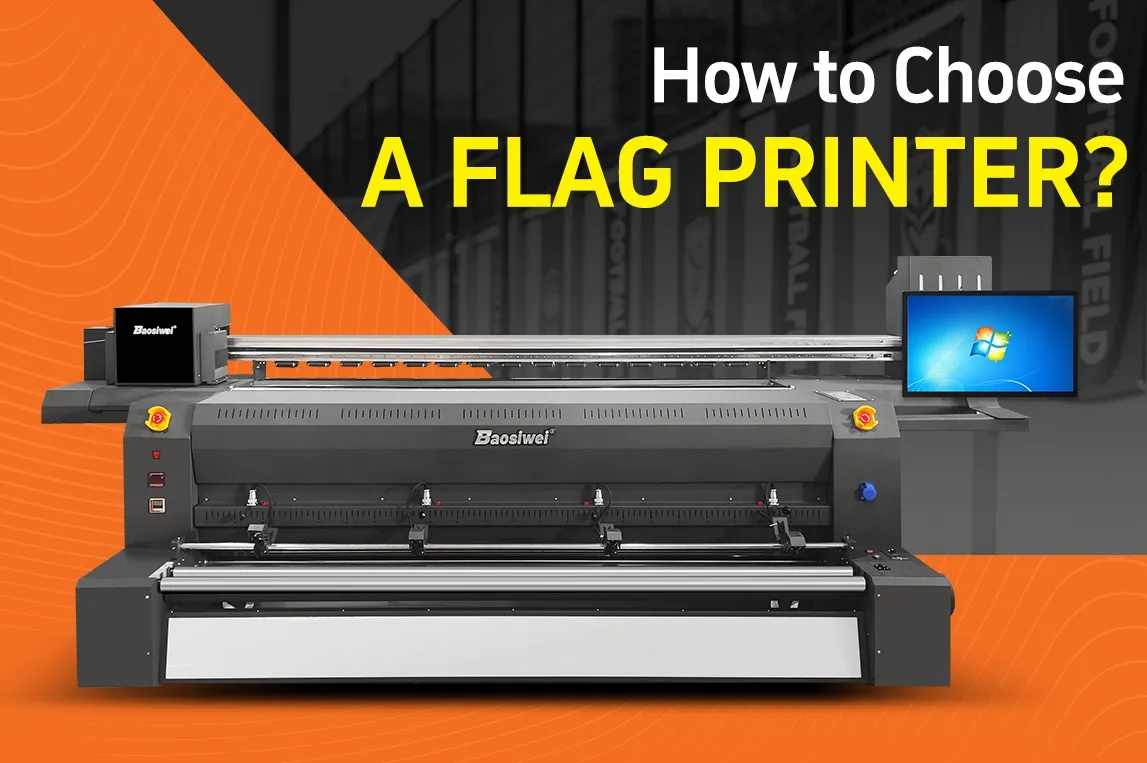
How to Choose a Flag Printer? Baosiwei JW-2204K 2.2m Wide Format + Integrated Printing & Heat-Fixing Solution
How to Choose a Flag Printer? Baosiwei JW-2204K (2.2m Wide Format + Integrated Printing & Heat-Fixing Solution)
Across global markets, flag fabrics and backlit textiles are showing the same production trends: larger sizes, tighter lead times, and more demand from outdoor and large-event scenarios. Whether the order comes from festivals, sports events, retail promotions, government/public projects, or short-cycle temporary installations, the requirements for factories are essentially the same:
- Not only “able to print,” but able to run stable, keep quality consistent, and reliably take higher-margin orders during continuous production.
In practice, profitability is usually not determined by a single “top speed” figure. It is determined by two capabilities:
- Can you take higher-margin specifications and applications?
- Can you reproduce the customer’s visual result consistently—job after job, batch after batch?
Based on common production pain points from factory users worldwide, Baosiwei JW-2204K is positioned as a solution-oriented system built specifically for the flag industry, with the goal of helping flag and backlit textile production move from “taking orders” to stable mass production and sustainable profitability.
1) Common Industry Issue: Simple “Printer + Heat-Fixing Unit” Combination Leads to a Fragmented Workflow
Many factories start with a straightforward setup: printing equipment + a separate heat-fixing unit. It can be quick to deploy, but once production scales, the same problems tend to appear:
- The two machines are not designed as one coordinated system
- Compatibility and process-matching issues become more noticeable
- Output stability relies heavily on operator experience
- As a result, production stability and batch consistency are difficult to standardize
Baosiwei JW-2204K is positioned differently. It is an integrated printing + heat-fixing solution designed for the flag industry, where printing and heat-fixing are engineered around the same production target. For factories, this supports a more repeatable production rhythm and a clearer quality-control logic—reducing the volatility typically caused by fragmented workflows.
2) Print Width Determines Your Order Ceiling: 2m Flags & Backlit Jobs Must Be Printable
In global markets, 2-meter class flags and backlit textile applications are common. However, many widely seen flag printers are limited to 1.6–1.9m print width. This often forces factories into two options:
- Seaming/paneling: increased processes, higher risk, more uncertainty
- Rejecting the order: losing higher-margin work and being pushed into low-price competition
Baosiwei JW-2204K offers a 2.2m print width, designed to cover common market specifications for flags and backlit applications. The value of wide format is not just “it can be printed”—it expands the factory’s order range and supports an upgrade in order structure and margin potential.
3) Dark Graphics Are a True Deliverability Test: Ink Mist and Contamination Risks Must Be Controlled
Dark designs typically mean higher ink load and stronger coverage. In flag and backlit textile production, these are high-value visuals—but they also expose weaknesses in output cleanliness and process control. When contamination or ink mist issues appear, acceptance becomes stricter and the cost impact is immediate:
- customer dissatisfaction at inspection
- higher reject rates
- more rework and material loss
Baosiwei states that the ink system developed for the flag industry is focused on reducing these mass-production risks: minimizing image contamination and reducing the likelihood of ink mist. The value is not only “better-looking samples,” but more controllable delivery for dark jobs and lower hidden loss in batch production.
4) Color Performance Defines Premium Value: Vivid Output and Smooth Gradients Matter Most for Backlit & Event Use
Flags and backlit textiles are primarily viewed outdoors and at distance. Color impact is not a minor detail—it directly affects perceived quality and willingness to pay. Key factors include:
- vividness and saturation
- clarity of layers and tonal separation
- smooth, natural gradient transitions
With a high-spec ink setup and heat-fixing color-development capability, and supported by intelligent feathering technology, the JW-2204K is positioned to strengthen saturation and tonal performance, delivering vivid color and smooth gradient transitions—better suited for event and outdoor applications where visual performance is the competitive advantage.
Why JW-2204K Is Not the Lowest Price—Yet Can Be More Cost-Effective Long Term
In any market, low-priced equipment is easy to find. What is less common is equipment that can maintain stable delivery under high-load production and consistently support higher-margin order structures.
For factories, cost does not only occur at the time of purchase. Long-term operating cost is often driven by:
- downtime
- rework
- material waste
- delivery risk under tight schedules
Baosiwei’s product strategy is clear: invest in the factors that matter most for production outcomes—workflow completeness, 2.2m width coverage, cleaner output control for dark jobs, and strong color-development capability. JW-2204K is positioned not as “the cheapest option,” but as a system aimed at making production more controllable, stable, and aligned with premium-order delivery standards.
Typical Applications: Flags + Backlit Textiles (High-Value Global Use Cases)
JW-2204K is positioned to fit applications such as:
- 2m-class flag orders (closer to higher-margin demand ranges)
- backlit textile output (more sensitive to brightness and tonal layering)
- event banners and large outdoor graphics (tight lead times, batch production, stable delivery)
Free Sample Test: Verify Fit with Your Real Materials and Files
If you produce flags or backlit textiles and want to evaluate the fit of Baosiwei JW-2204K, the most reliable method is a sample test under realistic production conditions. To improve testing relevance, it is recommended to provide:
- material type (flag fabric / backlit textile) and typical specifications
- representative artwork files (preferably including dark areas and gradients)
- your priority: throughput-first or visual-performance-first
Baosiwei can provide sample testing recommendations and a matching printing solution approach based on your acceptance criteria. We also welcome industry users from around the world to visit the factory for evaluation and testing.