How Should Packaging Printing Factories Plan Their Equipment in 2026? A Comparison of Offset, Flexographic and Digital Printing
How Should Packaging Printing Factories Plan Their Equipment in 2026? A Comparison of Offset, Flexographic and Digital Printing
In 2026, AI is accelerating workflows across industries, and the packaging printing market is seeing more small-batch, multi-SKU and fast-turnaround orders. As customer requirements become more flexible, packaging factories also need greater flexibility in production.
For orders involving only a few hundred pieces, traditional processes such as plate making, press setup and production preparation can add time and cost. Digital printing eliminates the traditional plate-making step and can reduce part of the pre-production workload for certain small-batch orders. As AI is increasingly applied to file processing, layout, color management and production workflows, the response time for small-batch packaging orders can also improve.
At the same time, large-volume standard orders remain an important source of revenue for packaging printing factories. For orders of 10,000 pieces or more with stable designs and repeat production, offset and flexographic printing can still benefit from established processes and economies of scale. The actual cost crossover point, however, depends on factors such as paper type, package size, print area, finishing requirements and production costs.
This is creating a clearer division of equipment roles in packaging production in 2026:
Small-batch orders favor digital printing, while large-volume orders remain suited to traditional printing.
In this article, Baosiwei looks at how packaging printing factories can evaluate their equipment choices in 2026 by comparing offset, flexographic and digital printing.
1. What Production Requirements Are Best Suited to Offset, Flexographic and Digital Printing?
Offset, flexographic and digital printing all have established applications in the packaging industry. The right technology depends mainly on order volume, materials, product type and production workflow.
Offset printing is well suited to large-volume, stable-design cartons and premium packaging where print quality is important.
Flexographic printing is widely used for corrugated boxes, transport packaging and continuous high-volume production.
Digital printing is particularly suitable for small-batch, multi-SKU, personalized and fast-turnaround packaging orders. It can also be considered for certain large-format paper packaging applications.
For factories that already operate offset or flexographic equipment, adding digital printing can complement existing capacity and allow different orders to be assigned to the production process that fits them best.
2. Offset Printing: Still Strong for Stable, High-Volume Premium Carton Production
Offset printing has developed into a mature production process for cartons and premium packaging.
Typical applications include:
- Cosmetic cartons
- Food packaging boxes
- Gift boxes
- Electronics packaging
- Healthcare and personal-care packaging
- Premium retail packaging
When customers place large, repeat orders with stable SKUs and designs that do not change frequently, offset printing can benefit from economies of scale.
The costs associated with plate making and press setup can be distributed across a larger production volume. As order quantities increase, these preparation costs generally have less impact on the cost per package.
For an order of only a few hundred pieces, however, or an order containing dozens of different SKUs, plate making, press setup, plate changes and production preparation can represent a larger proportion of the total production cost.
For this reason, packaging factories can consider digital printing as one of the key production options for small-batch orders while keeping offset equipment focused on larger and more stable orders.
3. Flexographic Printing: A Clear Choice for High-Volume Corrugated Packaging
Flexographic printing has a strong connection with corrugated packaging and transport packaging.
For e-commerce shipping boxes, logistics boxes, industrial outer cartons, food transport packaging and other high-volume corrugated products, customers typically focus on:
- Continuous production capacity
- Equipment stability
- Production cost per unit
- Long-running performance
- Delivery capability for large orders
When a packaging factory produces the same or similar corrugated box specifications in large volumes, flexographic printing continues to offer clear production advantages.
However, when customers begin requesting small quantities, complex graphics or multiple designs, the plate-changing and preparation requirements of conventional flexographic production need to be considered carefully.
These orders can be assigned to digital printing where appropriate, allowing the flexographic line to remain focused on high-volume production.
4. Digital Printing: Small-Batch, Multi-SKU and Fast-Turnaround Orders
The biggest advantage of digital printing is production flexibility.
Traditional printing usually involves plate making, press setup and production preparation. Digital printing can output directly from a digital file, making it particularly useful for several types of packaging orders.
1. Small-Batch Packaging Orders
For example, a brand may only need 500, 1,000 or several thousand cartons.
There is no universal order quantity at which digital printing becomes more economical. Actual costs depend on paper type, package size, print area, colors, finishing, equipment depreciation and labor.
When the preparation cost of a traditional process is relatively high, small-batch digital printing may provide a more suitable cost structure.
2. Multi-SKU Packaging Orders
Consider a customer that needs 20 different package designs, with only a few hundred pieces for each SKU.
With a traditional printing process, each SKU may require separate plate preparation and production setup.
Digital printing can switch between different digital files with much less preparation, reducing the production burden associated with frequent changes between SKUs.
3. New Product Testing
New brands and new products often need a limited quantity of packaging before a full-scale launch.
A packaging factory can produce several hundred or several thousand packages for market testing, channel testing or product validation.
If the product performs well and order volumes increase, the production method can then be evaluated again based on the new order volume and cost structure.
4. Packaging Versions for Different Markets
Export-oriented businesses often need to modify packaging according to different markets, including languages, product information, regulatory requirements or promotional content.
For example, the same product may require English, German and French versions, with relatively small quantities for each market.
This type of multi-version, small-batch production is well suited to digital printing.
5. Urgent Reorders and Fast Turnaround
Product launches, seasonal promotions and e-commerce campaigns can create packaging orders that need to be produced within a short timeframe.
By reducing part of the traditional pre-production process, digital printing can give packaging factories greater flexibility when responding to these orders.
For orders where the artwork and materials have already been confirmed, digital printing can reduce certain plate-making and setup steps and provide a more flexible route to fast delivery.
6. Large-Format Cartons and Large Paper Packaging
Digital printing is not limited to small-batch orders.
Large-format cartons, large paper boxes, display packaging and other special-size paper packaging can also be suitable applications for wide-format digital printing.
These orders often have one common characteristic:
The package is large, but the order quantity may not be large.
For example, packaging for home appliances, furniture-related products, display boxes, gift packaging and other special-size paper boxes may require a large print area while the order volume from an individual customer remains relatively limited.
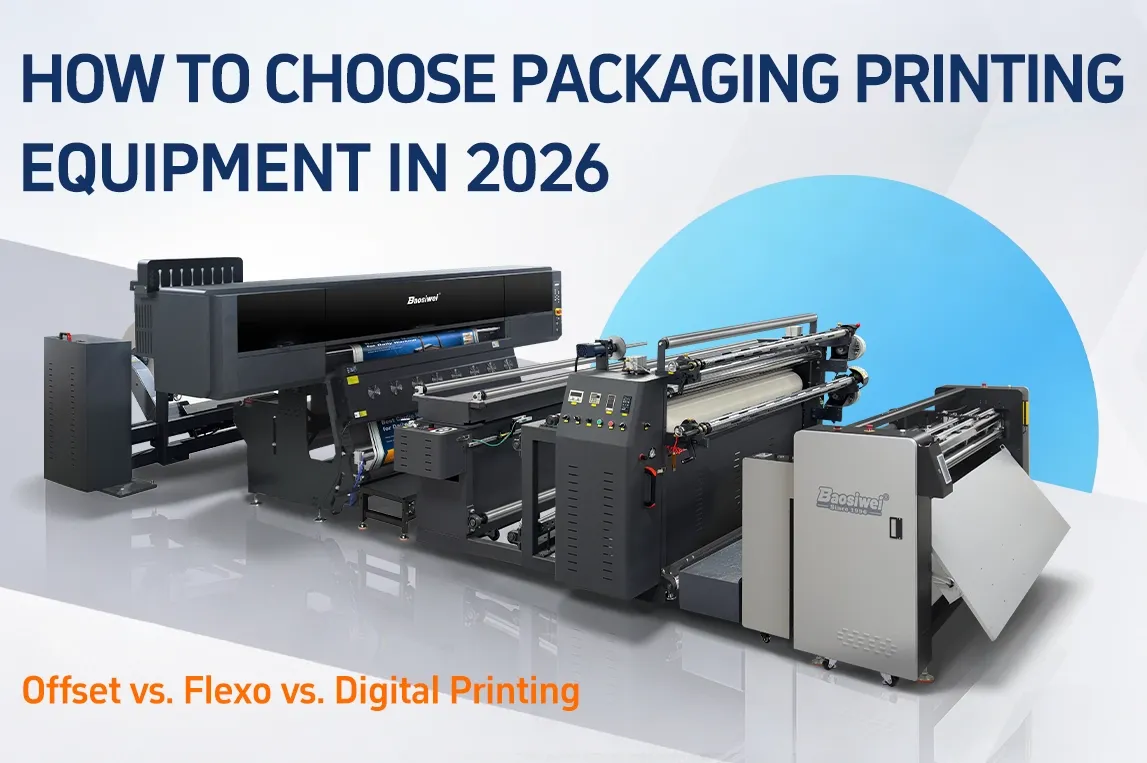
Some Baosiwei packaging digital printing equipment can provide a printing width of up to 1.8 meters, allowing certain large-format paper packaging applications to be considered. Typical materials include white card stock, grey-back white paper and kraft paper.
For conventional packaging production, large-format packaging needs to be matched with equipment width, plate making, production preparation and finishing requirements. When the order quantity is limited but the package requires a large printing area, digital printing provides another flexible production option.
This means the application range of digital printing in packaging can be summarized as:
Small-batch + multi-SKU + fast turnaround + large-format paper packaging.
5. How Can Packaging Factories Build Small-Batch Digital Printing Capacity Alongside Traditional Equipment?
For factories that already have offset or flexographic equipment, replacing one printing technology with another is not necessarily the practical approach.
A more flexible production strategy is to assign different orders according to their production requirements.
- High-volume premium cartons → Offset printing
- High-volume corrugated transport packaging → Flexographic printing
- Small-batch cartons → Digital printing
- Multi-SKU orders → Digital printing
- New product testing → Digital printing
- Urgent reorders → Digital printing
- Large-format cartons and paper boxes → Digital printing
For example, a new brand may place a small initial packaging order for market testing. The factory can use digital printing to produce the required quantity without committing the order to a large-volume conventional production process.
If the product performs well and the order volume increases, the factory can reassess the production method based on quantity and overall production cost.
The same principle can be applied to large-format paper packaging. When the package is large but the order quantity is limited, a wide-format digital printing process can provide another production option, depending on the material and finishing requirements.
This type of combined production strategy allows each printing technology to handle the orders it is better suited to produce.
6. Which Packaging Factories Can Benefit from Baosiwei Digital Printing Equipment?
Baosiwei provides digital printing equipment for packaging applications, with a focus on small-batch, multi-SKU, fast-turnaround orders and selected large-format paper packaging applications.
For packaging factories that already operate traditional printing equipment, digital printing can be introduced as a complementary production capability.
For example:
Traditional printing factories:
Add digital printing equipment to handle small-batch and multi-SKU packaging orders, as well as selected large-format, small-volume paper packaging jobs that may not fit efficiently into existing production processes.
Advertising printing companies:
Expand from posters, displays and other advertising materials into small-batch cartons and packaging boxes.
Multi-SKU packaging factories:
Use digital printing to reduce the production pressure caused by frequent design changes and SKU switching.
Fast-turnaround packaging factories:
Build a more flexible workflow for new products, promotions and urgent reorders.
Large-format paper packaging producers:
Use wide-format digital printing to explore additional applications such as large cartons, paper boxes and special-size packaging.
The right equipment should ultimately be selected according to the factory's actual orders, materials, package dimensions and finishing process rather than by comparing a single machine specification.
Conclusion
Offset, flexographic and digital printing each have their own role in packaging production.
Offset printing remains well suited to large-volume, high-quality cartons. Flexographic printing is widely used for high-volume corrugated and transport packaging. Digital printing is particularly useful for small-batch, multi-SKU, personalized, new-product testing and fast-turnaround orders, as well as selected large-format paper packaging applications.
For packaging printing factories in 2026, equipment planning can move beyond the question of “Which printing technology should we choose?”
A more practical question is:
“Which type of order should each printing technology handle?”
If your factory is evaluating small-batch cartons, multi-SKU packaging, large-format paper packaging or fast-turnaround production, prepare information such as material type, typical order quantity, number of SKUs, package dimensions, target capacity and current production workflow.
Based on these details, you can then evaluate which packaging digital printing equipment and production configuration best fit your actual order structure.