
The 7 Most Overlooked Factors When Upgrading to Digital Printing for Folding Carton Production
The 7 Most Overlooked Factors When Upgrading to Digital Printing for Folding Carton Production
Introduction
As the packaging industry shifts toward shorter production runs, more product variations, and faster delivery, an increasing number of folding carton manufacturers are considering digital printing to improve their production flexibility and competitiveness.
However, upgrading to digital printing is about much more than adding a new machine. During project planning, many companies focus on printhead quantity, printing speed, or equipment price while overlooking several critical factors that have a much greater impact on long-term return on investment.
Based on our experience working with packaging manufacturers worldwide, here are seven of the most commonly overlooked factors that can determine whether a digital printing upgrade is truly successful.
1. Is Your Current Order Structure Really Suitable for Digital Printing?
Many folding carton manufacturers assume that digital printing is automatically more advanced and more efficient than conventional printing.
The reality is that digital printing is not the best solution for every production scenario.
If your factory mainly produces large-volume folding cartons with fixed designs and long production runs, conventional offset printing still offers significant advantages. However, if your business is handling more SKUs, smaller order quantities, shorter lead times, and frequent design changes, digital printing can deliver much greater value.
Before investing in new equipment, review your order data from the past 12 months, including average order quantity, SKU volume, repeat order frequency, and sampling requirements. This will help you determine which jobs are best suited for digital printing and whether it can reduce operating costs while improving your ability to win more business.
2. Do More Printheads Always Mean Higher Productivity?
One of the first questions customers ask is:
"What's the difference between an 8-head, 16-head, and 24-head printer?"
While additional printheads can increase production capacity, they are far from the only factor that determines productivity.
As printhead numbers increase, higher demands are placed on the ink delivery system, motion control, machine frame, automatic feeding, and unloading systems. Without a well-designed machine and reliable engineering, a higher printhead configuration does not necessarily translate into stable long-term production.
High-end configurations require not only advanced equipment but also strong engineering capabilities and complete production line integration.
For folding carton manufacturers handling frequent job changes, a stable production system that matches their order volume and allows fast job switching is often far more valuable than simply pursuing the highest printing speed.
3. Are You Planning Only the Printer, or the Entire Production Workflow?
Many companies assume that upgrading to digital printing simply means purchasing a digital printer.
In reality, the printer is only one part of the production process.
Even if printing speed increases significantly, overall productivity may still be limited if loading, laminating, cutting, or material handling continue to rely heavily on manual labor.
When planning a digital printing project, it's important to evaluate the complete production workflow rather than focusing on the printer alone.
Questions worth asking include:
- Is material feeding automated?
- How will printed sheets move to lamination and cutting?
- Can each production stage connect smoothly?
These factors directly influence real production efficiency.
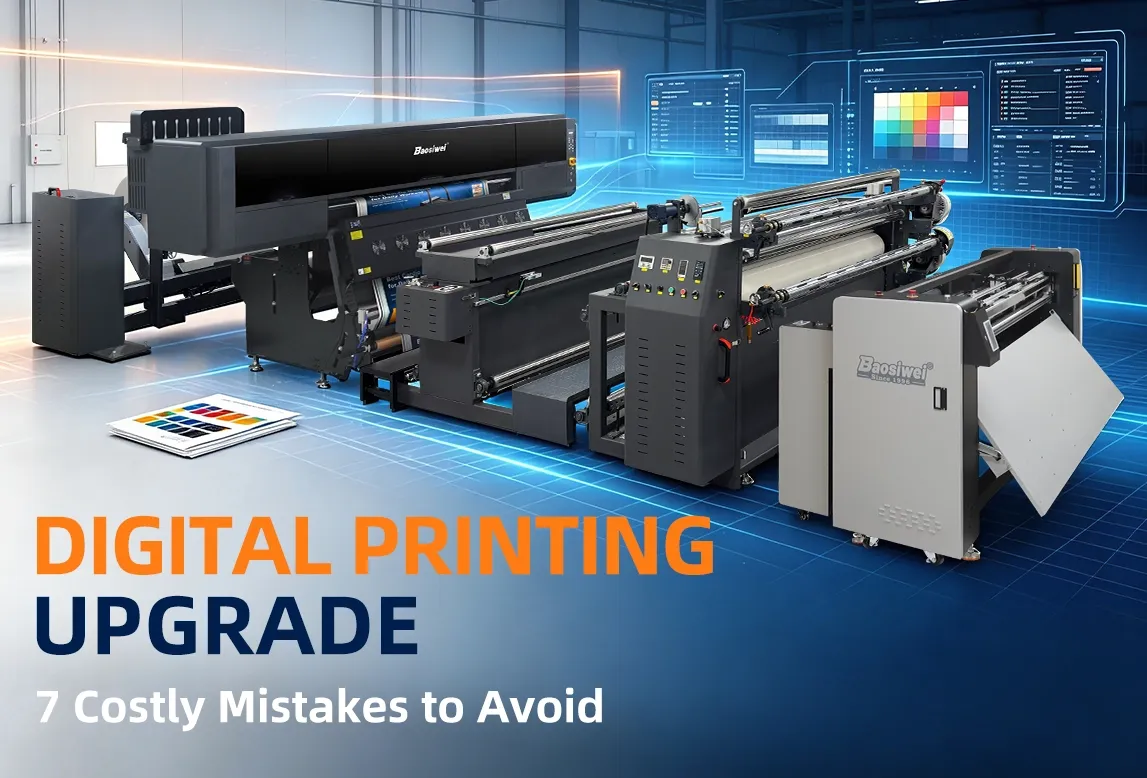
To address these challenges, Baosiwei has developed an integrated production solution for folding carton printing that combines automatic feeding, digital printing, web guiding, laminating, and sheet cutting. By reducing manual handling and waiting time, printed carton sheets can move directly to the mounting process, significantly improving overall production efficiency.
4. Have You Tested Your Own Materials and Production Process?
Many digital printing demonstrations produce excellent results.
However, actual production may present different challenges, including color variation, insufficient ink adhesion, or inconsistent printing quality.
In many cases, the equipment itself is not the problem. The difference lies in the materials being used.
Different paper suppliers, paper weights, white cardboard, coated paper, gray-backed white board, and even different production batches can all affect printing performance.
For this reason, we always recommend that customers bring their own substrates, packaging samples, and production requirements to our showroom for live testing instead of relying solely on demonstration samples.
Only real production testing can provide reliable results for future mass production.
5. Have You Calculated the Total Cost of Production?
Equipment price is often the first thing buyers compare.
However, the purchase price represents only part of the investment.
The real profitability of digital printing depends on long-term operating costs and overall return on investment.
Questions worth evaluating include:
- Is the ink quality stable, and what is the printing cost per square meter?
- Will the new production line require additional factory space or supporting equipment?
- How long will it take for the investment to reach break-even?
- How much can digital printing reduce plate-making costs, inventory, and material waste for short-run jobs?
- Can digital printing help your company secure new business opportunities that were previously difficult to accept?
Looking beyond the initial equipment price provides a much clearer picture of the true value of your investment.
6. Can Digital Printing Replace Conventional Printing?
This is one of the most common misconceptions.
Today, more packaging manufacturers are combining conventional printing with digital printing rather than choosing one over the other.
Offset or flexographic printing continues to handle large-volume standard production, while digital printing is used for short-run jobs, promotional packaging, regional packaging, prototype development, and urgent repeat orders.
Digital printing is not designed to replace traditional printing.
Instead, it complements conventional production by handling the types of orders that traditional printing is less efficient at producing.
This combination allows manufacturers to improve equipment utilization while becoming more responsive to changing customer demands.
7. Will the Equipment You Buy Today Still Meet Market Demands Three Years From Now?
The packaging industry is evolving rapidly.
Brands are launching products more frequently, SKU counts continue to increase, and demand for e-commerce packaging, customized packaging, regional marketing campaigns, and personalized packaging is growing every year.
If equipment selection is based only on today's production needs, another upgrade may become necessary sooner than expected.
When planning a digital printing investment, manufacturers should consider not only current production requirements but also future business growth and market trends.
Choosing a solution with room for expansion can provide much greater long-term value.
Conclusion
Introducing digital printing into a folding carton factory is far more than purchasing another piece of equipment. It represents a transformation in production capability and business strategy.
Factors such as order structure, equipment configuration, workflow integration, material compatibility, and future business planning all play an important role in determining the success of a digital printing investment.
If you are considering upgrading your folding carton production with digital printing, we welcome you to visit Baosiwei with your own packaging samples, substrates, and production requirements. Through live testing and practical evaluation, we can work together to identify a digital printing solution that fits your production needs and supports sustainable business growth for years to come.