
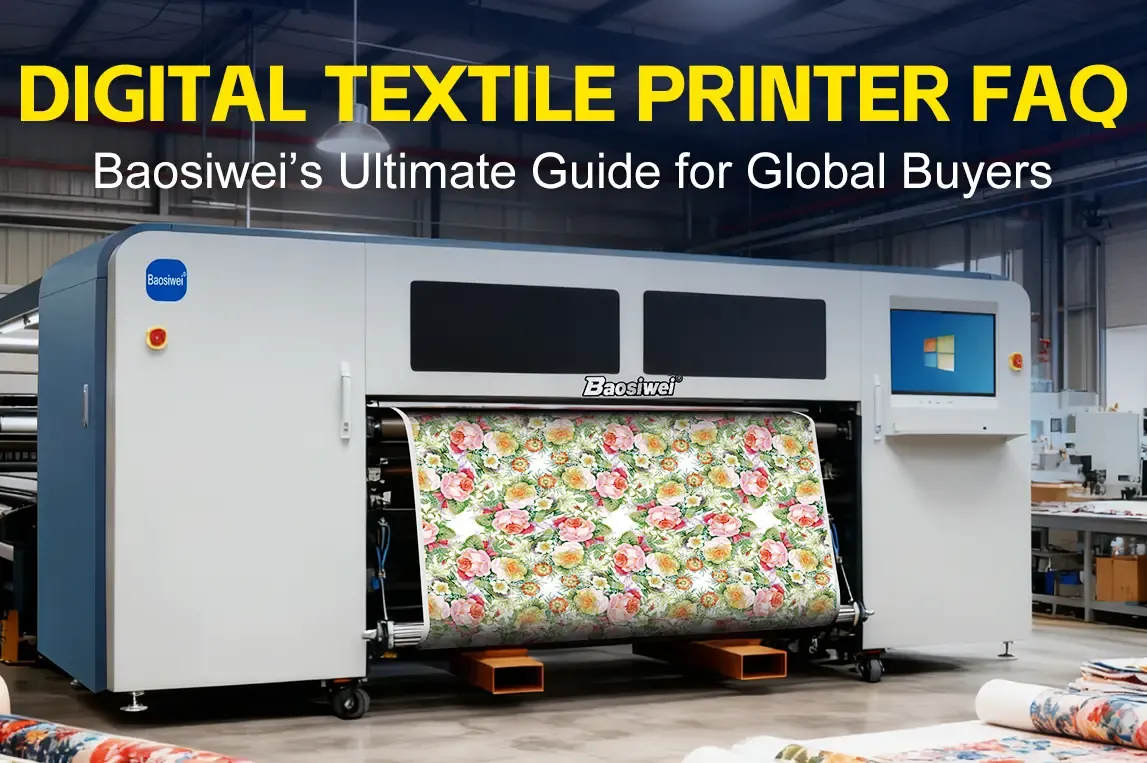
Digital Textile Printer FAQ — Baosiwei’s Ultimate Guide for Global Buyers
Digital Textile Printer FAQ — Baosiwei’s Ultimate Guide for Global Buyers
As demand for small batches, multiple SKUs, and fast delivery grows across Europe, the U.S., and Asia, more factories are considering digital textile printing. Yet in daily communication, both beginners and experienced producers often face similar questions:
Can all fabrics be printed?
Is the colorfastness good enough for the EU/US?
Is the speed truly production-ready?
Will the print feel stiff?
And most importantly — how do you identify a reliable digital textile printer manufacturer?
This guide compiles the 8 most frequently asked questions from global buyers, with clear and practical answers based on Baosiwei’s 30 years of textile digital printing experience.
Q1|What types of digital textile printers exist, and how are they different from traditional printing?
The most common digital textile printing systems are:
- Dye Sublimation Printers – best for polyester sportswear and activewear
- Direct-to-Garment (DTG) Printers – ideal for cotton and small batches
- DTF Film Printers – compatible with nearly all fabrics, suited for customization business
Key differences from traditional printing:
- No plate-making (no screens, no paste)
- Very low cost for small batches
- Unlimited design variations
- Fast turnaround, ideal for reorders
- Superior detail for gradients and HD graphics
Digital printing isn’t meant to replace traditional methods; it simply becomes the best solution for multi-style, small-lot, high-flexibility production.
Q2|Can digital printers print on all fabrics? What fabric requirements should I know?
Not all fabrics can be printed directly, but most can be printed with a matched ink system + correct workflow.
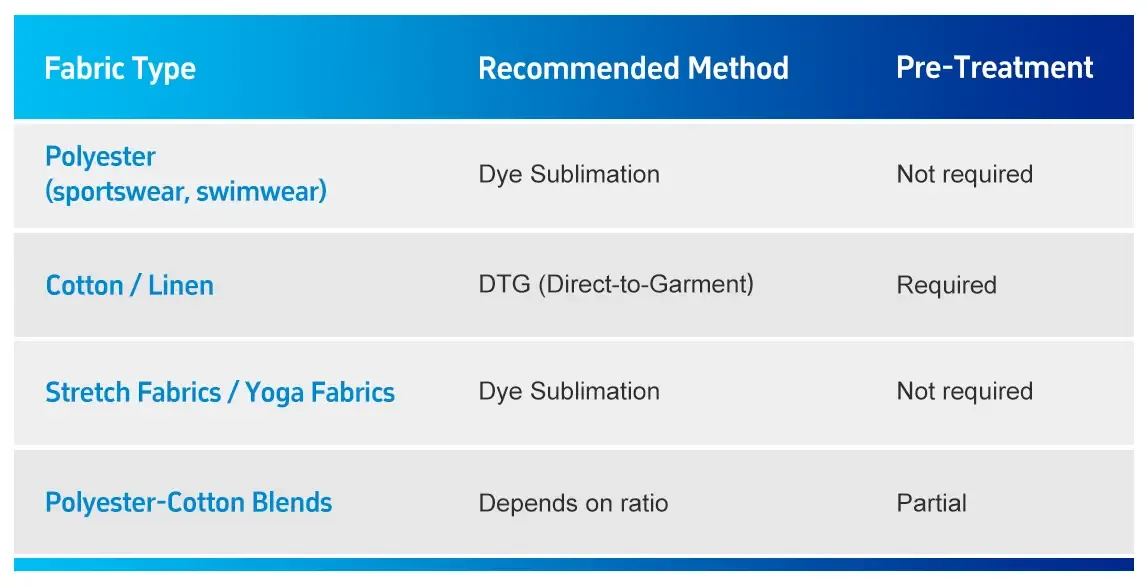
Because textile compositions vary widely, no factory can judge suitability by description alone.
Baosiwei suggests sending a fabric sample for free testing before choosing a printing method.
Q3|Can digital textile printing meet EU/US colorfastness standards?
Colorfastness depends on the ink system and process, not the printer itself.
Key factors include:
- Ink type (pigment / reactive / acid / disperse / sublimation)
- Fabric construction
- Quality of pre-treatment
- Correct drying/curing parameters
Under Baosiwei’s optimized workflow:
- Wash fastness: 4–5 grade
- Dry/Wet rubbing fastness: 4–5 grade
Fully compliant with mainstream European and American textile standards.
Q4|Will the printed fabric feel stiff? Does digital printing affect breathability?
Hand-feel is mainly influenced by the ink and the pre-treatment.
① Ink system
- Sublimation ink: zero hand-feel, no added weight, no impact on breathability
- DTG ink: slight hand-feel depending on fabric thickness
- DTF film ink: film areas may feel less breathable; not recommended for full-coverage graphics
② Pre-treatment
- Too heavy → stiff / boardy
- Too light → poor color saturation
Baosiwei performs fabric hand-feel tests and adjusts pre-treatment concentration so customers enter production with confidence.
Q5|What is the real production speed? Are the numbers on websites accurate?
Actual speed depends on:
- Printhead type and quantity
- Fabric tension and ink absorption
- Printing mode (draft / production / high-quality)
- Dryer configuration
Industry speed references:
- Dye Sublimation: 180–900 m²/h (industrial models)
- DTG (cotton): 200–300 m²/h
- DTF film: 10–20 m²/h (customization business)
For mass production, we recommend 16-head or 24-head industrial configurations with stable feeding systems.
Q6|What digital textile printer models does Baosiwei offer? What are the differences?
Our core categories include:
Dye Sublimation Printers
4-head, 8-head, 16-head, 24-head
→ for sportswear, yoga fabrics, home textiles, and high-volume orders
Cotton DTG / Industrial Direct-to-Fabric Printers
- Dual-station DTG
- Industrial model BSW-1816
DTF Film Printers
Desktop, 30 cm, 60 cm, 1.2 m, 1.6 m
Provide your fabric type and expected daily output, and we will recommend the best-fit configuration.
Q7|Which printing method is best for sportswear, swimwear, and yoga fabrics?
These fabrics are typically polyester blended with spandex, making dye sublimation the most suitable option.
Benefits of sublimation for activewear:
- Zero hand-feel, breathable, skin-friendly
- Excellent color vibrancy
- No cracking, no fading
- Elasticity is not affected
- Outstanding detail reproduction
This is why over 90% of global sportswear and swimwear is produced using sublimation printing.
Q8|How do I choose the right digital textile printer? What makes Baosiwei a reliable supplier?
We suggest evaluating from five angles:
- What fabrics will you print?
- What is your expected daily output?
- Do you have pre- and post-processing equipment?
- Is colorfastness, hand-feel, or ink cost your priority?
- What is your budget?
Why buyers choose Baosiwei:
- In-house R&D for both printers and ink
- Professional ICC/color-management team
- Stable mechanical structure designed for continuous production
- Low failure rate and easy maintenance
- Online and on-site service support
- Faster delivery and stronger supply chain for industrial production
A trustworthy manufacturer won’t push the most expensive machine — but the most suitable workflow for your fabric, volume, and business model.
Conclusion: Choosing a digital textile printer is about the entire workflow — not just the machine
Global buyers care about more than “Can it print?”:
- Is it stable?
- Will it meet international standards?
- Is maintenance simple?
- Can the supplier provide real support?
- Will the solution help my orders grow steadily?
Baosiwei’s goal is simple:
Your machine should run smoothly from Day 1 and deliver long-term, profitable production.
We offer:
- Free fabric testing
- Free sample printing
- Live factory tours or on-site visits
- Customized machine recommendations based on your materials and budget
Feel free to contact us anytime.