
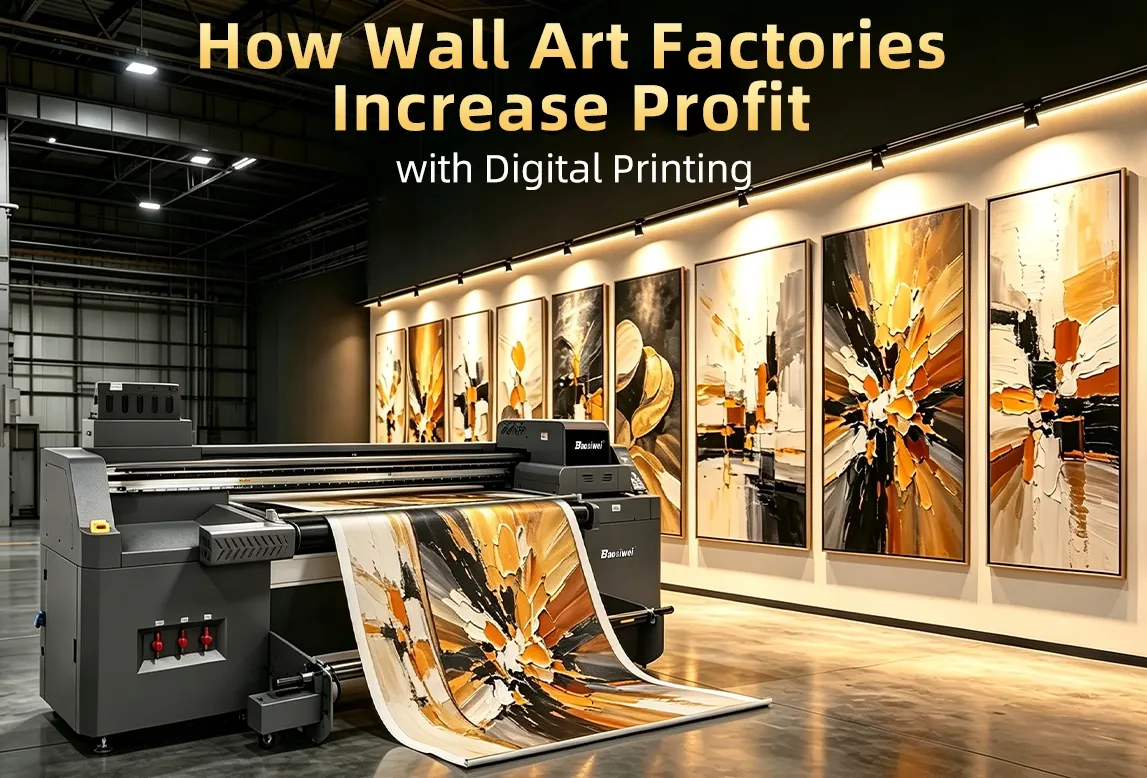
How Decorative Wall Art Factories Can Increase Profit Through Digital Printing Instead of Price Competition
How Decorative Wall Art Factories Can Increase Profit Through Digital Printing Instead of Price Competition
Introduction
As the decorative wall art market becomes increasingly competitive, price competition has become the norm for many manufacturers. While high-volume production can keep factories busy, shrinking profit margins make it difficult to achieve sustainable growth.
At the same time, demand for premium-quality, customized, and value-added wall art continues to rise. More buyers are looking for richer colors, textured finishes, and unique decorative effects that standard production methods often struggle to deliver.
For factories with established production lines, replacing existing equipment or changing their entire workflow can be both costly and risky. So, how can manufacturers create new revenue opportunities without disrupting their current production?
This article explores how a decorative wall art factory in Shenzhen gradually expanded its product portfolio through digital printing technology, opening new profit channels while maintaining its existing production capacity.
Why Is It Becoming Harder to Profit from Low-Cost Mass Production?
For many years, standardized decorative paintings dominated the market because they were easy to produce, cost-effective, and suitable for large-scale manufacturing.
However, as more manufacturers entered the industry, product differentiation became increasingly difficult. Competing primarily on price has led to shrinking margins, while rising labor, material, and operating costs continue to put pressure on profitability.
Many wall art manufacturers now face similar challenges:
- Similar products are flooding the market, intensifying price competition.
- High-volume orders generate lower profits than before.
- Premium orders require higher print quality than existing equipment can provide.
- Younger consumers increasingly value design, texture, craftsmanship, and personalization over low prices.
The real challenge is no longer obtaining orders—it is creating products that offer higher added value and stronger market differentiation.
A decorative wall art factory in Shenzhen provides an excellent example of how gradual equipment upgrades can help manufacturers move beyond price competition.
Step 1: Add an 8-Color Printing Solution to Capture Premium Orders
Like many manufacturers, this factory originally focused on large-volume production of standard decorative paintings. Production remained stable, and the company had built a reliable customer base over the years.
However, as competition intensified, relying solely on mass production no longer generated satisfying profits. Meanwhile, demand for premium artwork continued to grow. Customers increasingly requested cleaner highlights, smoother gradients, richer colors, and more detailed image reproduction—requirements that conventional printing equipment struggled to achieve.
Rather than replacing its existing production line, the factory introduced a Baosiwei 8-color eco-solvent printer dedicated to premium canvas artwork.
Compared with conventional printing solutions, the 8-color configuration delivers several advantages for high-end decorative printing:
- Cleaner and smoother light-color reproduction
- More natural color transitions and gradients
- Higher color gamut for richer visual expression
- Better reproduction of fine artistic details
- Improved image depth and layering
These improvements allow manufacturers to produce premium canvas artwork, art reproductions, decorative paintings, and gallery-quality prints with significantly higher visual quality.
Most importantly, the factory was able to continue its high-volume production while simultaneously accepting premium-value orders that were previously out of reach. Instead of competing solely on price, it successfully established a higher-margin product line and expanded its customer base.
Step 2: Introduce Texture Printing to Differentiate Products
After securing a steady flow of premium artwork orders, the factory did not stop upgrading its capabilities. Instead, it continued to monitor changing consumer preferences and emerging market trends.
In recent years, textured wall art has gained significant popularity among younger consumers, interior designers, hotels, and commercial decoration projects. Compared with traditional flat artwork, textured paintings create a stronger visual impact through raised surfaces and three-dimensional effects, making them a popular choice for modern interior spaces.
Recognizing this opportunity, the factory invested in a Baosiwei Texture Painting Printer.
Using white ink layering technology, the printer creates natural embossed textures directly on the canvas surface, producing a realistic three-dimensional effect without the labor-intensive manual processes traditionally required.
Compared with handcrafted texture artwork, digital texture printing offers several advantages:
- Consistent print quality across every piece
- Higher production efficiency
- Lower labor costs
- Faster delivery times
- Flexible production for both small and medium-sized orders
By adding a textured artwork product line, the factory successfully differentiated itself from competitors offering standard decorative paintings and entered a growing market segment with higher profit potential.
Step 3: Upgrade with UV Foil Printing for Premium Customization
Once both premium flat artwork and textured paintings became stable product lines, the factory took another step forward by introducing UV foil printing.
Unlike traditional hot stamping processes that require customized metal molds, digital UV foil printing eliminates mold production altogether. The process begins by printing a precisely positioned layer of white ink, CMYK color, and varnish onto the canvas, followed by foil transfer to create metallic decorative effects with excellent registration accuracy.
This digital workflow offers several advantages:
- No mold manufacturing required
- Precise foil positioning
- Short setup time
- Suitable for customized and short-run production
- Greater design flexibility
The factory also experimented with combining textured printing and UV foil finishing in a single artwork.
The raised texture creates depth, while metallic foil highlights selected design elements, producing artwork with both tactile and visual appeal. These premium products are particularly suitable for luxury residential interiors, hotels, commercial spaces, galleries, and customized decorative projects.
By integrating multiple digital finishing technologies, the factory successfully expanded into the premium customization market and secured higher-value orders with stronger profit margins.
Step 4: Build Multiple Profit Streams Instead of Expanding Production
Looking back, the factory's transformation was not driven by aggressive expansion or replacing its existing production system.
Instead, it adopted a gradual upgrade strategy.
Its original production line continued serving large-volume orders, while new equipment was introduced step by step to create additional product categories with higher added value.
The resulting product structure became much more diversified:
- Standard decorative wall art for high-volume production
- Premium-quality canvas artwork
- Textured paintings with embossed effects
- UV foil decorative artwork for luxury customization
This layered product portfolio enabled the factory to serve different customer segments while improving overall profitability.
Rather than relying solely on lower prices or larger production volumes, the company increased revenue by offering products with varying quality levels, applications, and value-added finishing options.
For many decorative wall art manufacturers, this gradual approach represents a practical and lower-risk path toward sustainable growth.
Frequently Asked Questions
1. Why are decorative wall art manufacturers facing lower profit margins?
As more factories enter the market, product differentiation becomes increasingly difficult. Combined with rising labor and material costs, relying solely on price competition often leads to shrinking profits.
2. What are the advantages of an 8-color printing solution?
An 8-color printer delivers a wider color gamut, smoother gradients, cleaner highlights, and finer image details, making it ideal for premium decorative paintings, canvas artwork, and art reproductions.
3. Can digital printing produce textured wall art?
Yes. Modern texture printing technology uses layered white ink to create embossed effects directly on the canvas, producing three-dimensional artwork without extensive manual craftsmanship.
4. What are the benefits of UV foil printing?
Digital UV foil printing requires no molds, offers precise positioning, supports short-run production, and creates premium metallic decorative effects for customized products.
5. Which markets have the greatest demand for textured and foil artwork?
Luxury residential decoration, hotels, commercial interiors, galleries, office spaces, and customized decorative projects are among the fastest-growing application markets for premium wall art.
6. How can decorative wall art factories increase profit without disrupting production?
Many manufacturers choose to retain their existing production lines while gradually adding premium printing, texture printing, and digital finishing technologies. This strategy allows them to diversify their product portfolio and increase profit margins without sacrificing production efficiency.
Conclusion
Today's decorative wall art market is no longer defined solely by production volume or pricing. Manufacturers that continue to compete only on cost often face shrinking margins and increasing competitive pressure.
The Shenzhen factory featured in this case demonstrates that gradual investment in digital printing technology can create new revenue opportunities without disrupting existing production. By adding premium printing, textured artwork, and UV foil finishing, the factory successfully built multiple product categories that serve different market segments and deliver higher added value.
For manufacturers looking to expand beyond traditional decorative paintings, digital printing offers a practical way to improve product quality, shorten production cycles, support customized orders, and increase profitability.
If you're exploring digital printing solutions for decorative wall art, canvas artwork, textured paintings, or premium decorative applications, Baosiwei can help you evaluate the right equipment and workflow based on your production requirements and business goals.