2026 Paper Packaging Industry Trends: Folding Carton Growth and New Opportunities for Digital Printing
2026 Paper Packaging Industry Trends: Folding Carton Growth and New Opportunities for Digital Printing
In 2026, the paper packaging industry is facing several important changes, including evolving market demand, stricter environmental requirements, and growing demand for customized packaging. This article examines the growth outlook for folding cartons, the impact of the EU Packaging and Packaging Waste Regulation (PPWR), and the opportunities for digital printing in short-run, multi-design, and large-format paper packaging production. It also explains how Baosiwei’s water-based ink printing solutions, 1.83 m print width, and integrated printing, laminating, and cutting line can help packaging manufacturers explore new business opportunities.
1. Folding Carton Market Growth: Which Orders Should Packaging Manufacturers Target?
Market research forecasts suggest that the global folding carton market could grow from approximately US$1,985.5 million in 2026 to US$3,203.7 million by 2035, representing a compound annual growth rate (CAGR) of around 5.46%.
Packaging for food, cosmetics, wine and spirits, gifts, and consumer goods often involves new product launches, seasonal promotions, packaging redesigns, and multiple product sizes. These requirements can create opportunities for packaging manufacturers to handle short runs, multiple designs, tight deadlines, and larger-format packaging projects. Some orders involve relatively small quantities but require frequent artwork changes, while others need larger print areas or specific paper weights.
Traditional printing remains well suited to high-volume production. However, plate-making, setup time, changeovers between jobs, and the unit cost of short runs can all influence whether a job is commercially viable.
Short-run digital printing for color boxes reduces the setup requirements associated with changing artwork. This gives packaging manufacturers more flexibility to handle product samples, small orders, repeat orders, and customized packaging in multiple designs. For factories that already operate conventional printing equipment, digital printing can complement existing production rather than replace it.
2. Three Paper Packaging Trends to Watch in 2026
2.1 Environmental Requirements: Ink and Material Documentation Matters
For packaging manufacturers serving export markets, environmental requirements may involve not only paper but also inks, coatings, adhesives, and the intended use of the finished package.
Buyers may request material specifications, test reports, and other compliance documentation. For food-contact packaging, suitability cannot be determined from the paper or ink type alone. The complete packaging structure, potential migration risks, and actual conditions of use must also be considered.
Water-based ink is an option worth evaluating for certain paper packaging applications. However, using water-based ink does not automatically make the finished package compliant with environmental regulations in a target market. Manufacturers should check the relevant ink documentation, paper compatibility, and specific customer requirements before choosing a printing solution.
2.2 Large-Format and Customized Paper Packaging: Print Width and Material Compatibility Matter
When a packaging business expands beyond standard color boxes into large-format cartons, heavy-duty color boxes, paper display structures, or other customized paper packaging, its equipment must accommodate different dimensions and material requirements.
Large-format printing depends on more than the printer's maximum print width. Paper weight, feeding method, material flatness, artwork positioning, and subsequent laminating, cutting, and converting processes can all affect the result.
When evaluating digital printers for large-format color boxes, manufacturers should look beyond maximum printing speed. Testing with their actual paper stocks and artwork helps establish whether the material feeds reliably, the graphics print correctly, and the printed sheets can move smoothly into downstream processing.
These factors are particularly important for businesses seeking to expand into large-format cartons, heavy-duty color boxes, and customized paper packaging.
2.3 Combining Traditional and Digital Printing to Match Different Orders
Traditional printing and digital printing serve different production needs. Traditional methods are generally suitable for high-volume orders with stable designs, while digital printing can be considered for product samples, short runs with multiple designs, and urgent repeat orders.
For example, a packaging factory may produce standard color boxes for established customers while also preparing packaging samples with different designs for new products. Using the same production method for every job may create unnecessary setup work for short runs, while switching all high-volume orders to digital printing may not be economically practical.
A more flexible approach is to allocate jobs according to order quantity, artwork changes, delivery deadlines, and finishing requirements. A digital printer for color box packaging gives manufacturers another option for handling short runs and multiple designs.
3. The EU PPWR Applies from August 2026: What Export Packaging Manufacturers Need to Know
The European Union's Packaging and Packaging Waste Regulation (PPWR, Regulation (EU) 2025/40) begins to apply on August 12, 2026. It covers areas including packaging composition, recyclability, and packaging waste management, with certain requirements being introduced in stages.
Official reference: European Commission — New EU rules on packaging enter into application
For packaging manufacturers supplying the European market, buyers may pay closer attention to packaging composition, recyclability, and the suitability of inks, coatings, and other components under applicable requirements. This reflects a broader shift toward packaging solutions that address environmental and material considerations.
Baosiwei's color box packaging printing solution uses water-based ink, and its ink has obtained OEKO-TEX certification. This provides an option for manufacturers evaluating ink characteristics and relevant material requirements. Compared with conventional solvent-based systems, water-based inks generally help reduce noticeable solvent odors.
However, water-based ink alone does not establish PPWR compliance. Manufacturers should assess the complete packaging structure, intended application, supporting documentation, and applicable regulatory requirements before making compliance claims.
4. Baosiwei Digital Printing Solutions for Color Box Packaging
4.1 Water-Based Ink Printing to Support a Transition Toward Greener Production
As buyers pay more attention to packaging materials and production conditions, Baosiwei offers water-based ink digital printing solutions for manufacturers exploring process improvements and alternative printing options. Export-oriented businesses should still review applicable regulations, ink test reports, and the intended use of the finished package.
4.2 1.83 m Print Width for Large-Format Packaging Applications
Baosiwei equipment offers a maximum print width of 1.83 m, supporting large-format paper packaging and heavy-duty color box production when the material and processing requirements are suitable. This gives manufacturers opportunities to expand into larger packaging formats and customized paper packaging projects.
4.3 Integrated Printing, Laminating, and Cutting to Reduce Material Handling
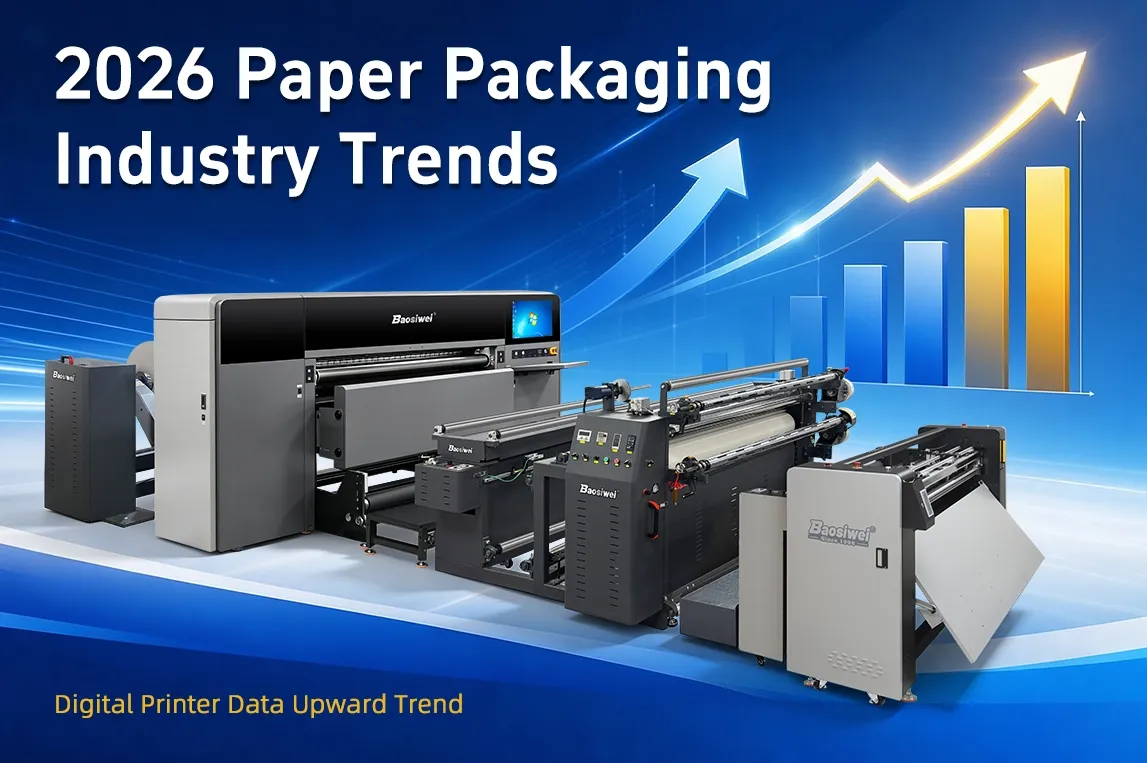
Baosiwei's integrated digital printing line for color box packaging connects printing, laminating, and cutting operations. By reducing material transfers and repeated handling between processes, the line helps streamline production flow and improve workflow organization.
5. How Can Packaging Manufacturers Turn Industry Changes into New Orders?
Market growth, environmental regulations, and changing customization requirements do not automatically generate more orders. Results still depend on a factory's customer base, product positioning, cost structure, and delivery capabilities.
Manufacturers focused on conventional high-volume color boxes can assess opportunities in short-run sampling, multi-design orders, and repeat orders. Those receiving requests for larger graphics or specialized paper packaging should also review equipment width, material compatibility, and downstream finishing capabilities.
For factories looking to increase production flexibility, digital printing for color box packaging can complement existing production methods. By allocating traditional and digital printing according to order quantity, artwork changes, and delivery requirements, manufacturers can choose a more suitable workflow for different jobs.
Contact Baosiwei to Explore a Paper Packaging Digital Printing Solution
If you are planning to expand into short-run color boxes, large-format cartons, or customized paper packaging, share the following details with Baosiwei:
- Paper types and grammage commonly used
- Finished packaging dimensions and print artwork
- Order quantity per design and expected daily output
- Whether laminating, cutting, or other finishing processes are required
Baosiwei can assess suitable equipment configurations based on your application and arrange sample testing to help you evaluate print quality, material compatibility, and production workflow before making a purchasing decision.
Contact Baosiwei
Website: www.baosiwei.com
Email: [email protected]